

Introduction
A frozen food bag can look acceptable at room temperature and still fail during filling, cold storage or distribution. Frozen product edges may load the film differently, seals may encounter frost or food particles, and repeated handling can reveal weaknesses that an empty sample does not show.
For food processors and overseas buyers, the practical task is to specify the whole packaging system. The food, film, bag geometry, sealing process, carton and cold-chain conditions all influence the result. Buying a thicker pouch without understanding the failure risk is an uncertain solution.
This guide explains how to compare frozen food packaging bags for vegetables, fruit, prepared foods and other suitable applications. It focuses on material questions, filling preparation and a trial plan that helps purchasing and production teams agree on a package before commercial release.
Quick Answer: What Should You Look for in Frozen Food Packaging?
Choose frozen food packaging by the actual product, filling conditions and distribution risks. Specify suitable cold-condition toughness, moisture protection, seal performance and handling strength. Compare complete constructions and test filled packs at defined temperatures. The words “freezer bag,” “food grade” or a thickness value do not independently prove suitability.
First confirm whether the product is packed before freezing or filled while already frozen. Then define the storage range, likely handling conditions, fill weight and intended consumer use. These details determine which samples and tests are meaningful.
1. Describe the Frozen Product and Its Journey
Separate the filling condition from the storage condition
The temperature at which a pack is sealed may differ from its later storage temperature. A food packed before freezing presents different seal-area conditions from individually frozen pieces filled into a bag. Identify the sequence rather than specifying only the freezer set point.
Record whether the product is dry, wet, oily, coated or likely to shed crumbs. Describe irregular shapes, hard corners, bones or shells where relevant. A photograph can help, but representative product and a written description provide a stronger basis for development.
If the package will encounter vacuum, gas flushing or a special treatment, disclose this at the start. A construction intended for ordinary frozen storage should not be assumed suitable for cooking, microwave heating, boiling or retort processing.
Map the distribution conditions
Describe storage duration, transfer points, export transport, retail presentation and expected consumer handling. Use the required operating range and actual route records where available. Do not use a single nominal temperature as a complete description of the cold chain.
For a development brief, write “storage at the buyer’s specified frozen range, with excursions assessed under the agreed validation plan.” Replace that wording with measured and approved limits before production. This is more useful than an unsupported claim that a bag handles any freezing condition.
2. Identify the Failures You Need to Prevent
Moisture loss and freezer burn
Frozen food quality can deteriorate when moisture is lost from the product. Packaging needs appropriate moisture protection and sound seals, while storage management remains part of the solution. University of Missouri Extension’s freezing guidance links moisture-vapor-resistant packaging with prevention of freezer burn. [1]
Do not present the bag as a substitute for temperature control or food-process validation. The appropriate package can support the product’s quality goals, but it cannot correct every problem introduced by freezing, storage or handling.
Puncture, cracking and abrasion
An irregular frozen piece can press against a small film area. Product movement inside the pack and rubbing against neighboring packs may create a different stress from a simple room-temperature tensile check.
Ask whether the candidate structure has been evaluated under representative cold conditions and with comparable product geometry. Amcor’s forming-film description for fresh and frozen food highlights toughness and puncture resistance alongside barrier properties, illustrating why those functions belong in the development brief. [2]
Seal defects and contamination
Frost, moisture, oil or particles in the sealing area can interfere with consistent closure. The correct response may involve product handling, filling control or seal setup as well as material selection.
Locate the defect before choosing a remedy. A crack near a fold, a puncture through a panel and a channel through the top seal point to different investigations. Photograph the failure and preserve the pack with its lot and trial conditions.
3. Compare Materials by Function
The laminate should combine the functions the application needs: sealing, mechanical strength, printing, moisture protection and any additional barrier. Buyers should request a description of the complete structure or an agreed performance-based specification.
PE-based sealing layers are common in many flexible packaging constructions, while other layers may contribute print support, stiffness, barrier or toughness. Resin grade, layer design and conversion conditions matter. The abbreviation on a quotation is not enough to predict finished-package behavior.
| Required function | Question for the supplier | Useful confirmation |
|---|---|---|
| Cold-condition handling | How is the structure assessed at the required conditions? | Representative conditioned-pack testing |
| Puncture resistance | Is the construction suited to the actual product shape? | Filled-pack handling and agreed mechanical assessment |
| Moisture protection | What measured performance is available? | Report with units, method and conditions |
| Sealing | What process window is proposed? | Trial on the intended sealing equipment |
| Printing and coding | Will the final surface suit the process? | Rub, code adhesion and readability checks as appropriate |
| Food-contact suitability | Does documentation match the application? | Records covering the supplied construction and intended use |
Avoid assuming that one material direction suits every frozen product. A smooth vegetable portion, sharp seafood item and oily prepared meal can place different demands on the package. Ask the supplier to connect each proposed property to a stated risk.
4. Choose Thickness After Defining Performance
There is no single correct thickness for every frozen food bag. Fill weight, product geometry, format, laminate, handling and production tolerances all influence the choice.
When comparing offers, state whether the quoted thickness refers to one wall of the complete laminate. Confirm the nominal value, tolerance and measurement basis. Otherwise, two quotations may appear equivalent while describing different constructions.
If the current bag fails, identify the location and conditions of failure before increasing gauge. More material may help some mechanical risks but will not necessarily resolve contaminated seals, poor dimensioning or unsuitable handling.
Develop a change plan with the supplier. Compare the current construction with a justified alternative, keep other trial conditions consistent and record what changed. This produces a clearer approval decision than repeatedly ordering thicker samples without a hypothesis.
5. Match the Bag Format to Filling and Use
Stand-up pouches, three-side-seal flat pouches and equipment-formed bags may all be candidates depending on the product and process. Start with the filling equipment and desired consumer experience rather than a preferred shape alone.
For a resealable retail pack, check whether the zipper remains accessible and usable after realistic cold handling. Evaluate the initial heat seal separately. A zipper should not be treated as a guaranteed replacement for the unopened pack’s sealing system.
For products packed on form-fill-seal equipment, rollstock specifications require their own review. Web width, repeat, print registration, orientation, core and winding need agreement with the equipment team. A premade-pouch drawing cannot substitute for a rollstock specification.
Check filled dimensions and carton fit. Leave enough space to fill and seal reliably without excessive compression. Where expansion during freezing is relevant, determine the appropriate allowance through the actual product process rather than a generic percentage.
6. Prepare the Filling and Sealing Trial
Confirm the equipment setup
Before samples arrive, identify the machine, operating mode, gripping or feeding limits and sealing-jaw condition. Confirm whether the product is packed manually, by a co-packer or on an automatic line.
Prepare a trial sheet with sample code, material revision, product condition, fill weight, ambient conditions and machine settings. Record temperature, dwell time, pressure and speed where applicable. The equipment and material suppliers should help establish an appropriate process window.
Control the seal area
Observe how product enters the bag and whether pieces, frost or liquid reach the intended sealing zone. Review filling clearance and product transfer before assuming the material is at fault.
Check both stable production and changes in operating conditions. Startup, pauses and restarts may reveal different behavior from a short ideal run. Record rejected packs and the cause assigned after examination; avoid reporting a favorable yield based only on selected successful samples.
Keep trial approvals specific
Approving a sample’s print does not approve its cold performance. Likewise, a satisfactory empty-bag test does not establish shelf life or filling-line compatibility. Use separate approval lines for appearance, size, function, processing and product validation.
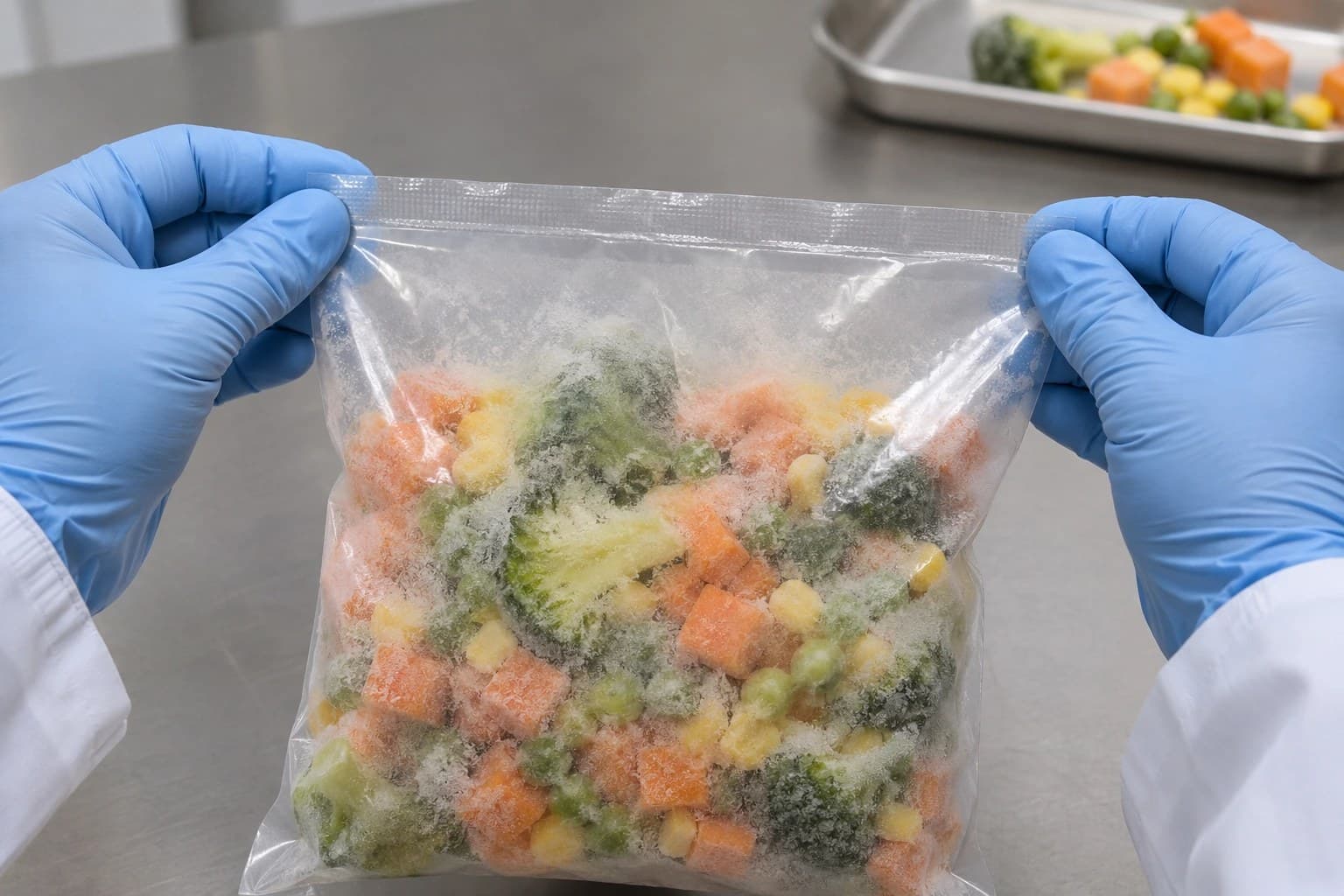
7. Build a Validation Plan Around the Filled Package
Condition samples appropriately
Test the actual product-and-package combination at defined conditions. Record conditioning time, pack temperature and the interval between removal from storage and testing. A package that has warmed substantially may no longer represent the intended handling state.
Agree on sample quantities, acceptance criteria and who performs each assessment before beginning. Trial quantities should reflect the development question and risk; a handful of attractive packs is not a statistically defined production-release plan.
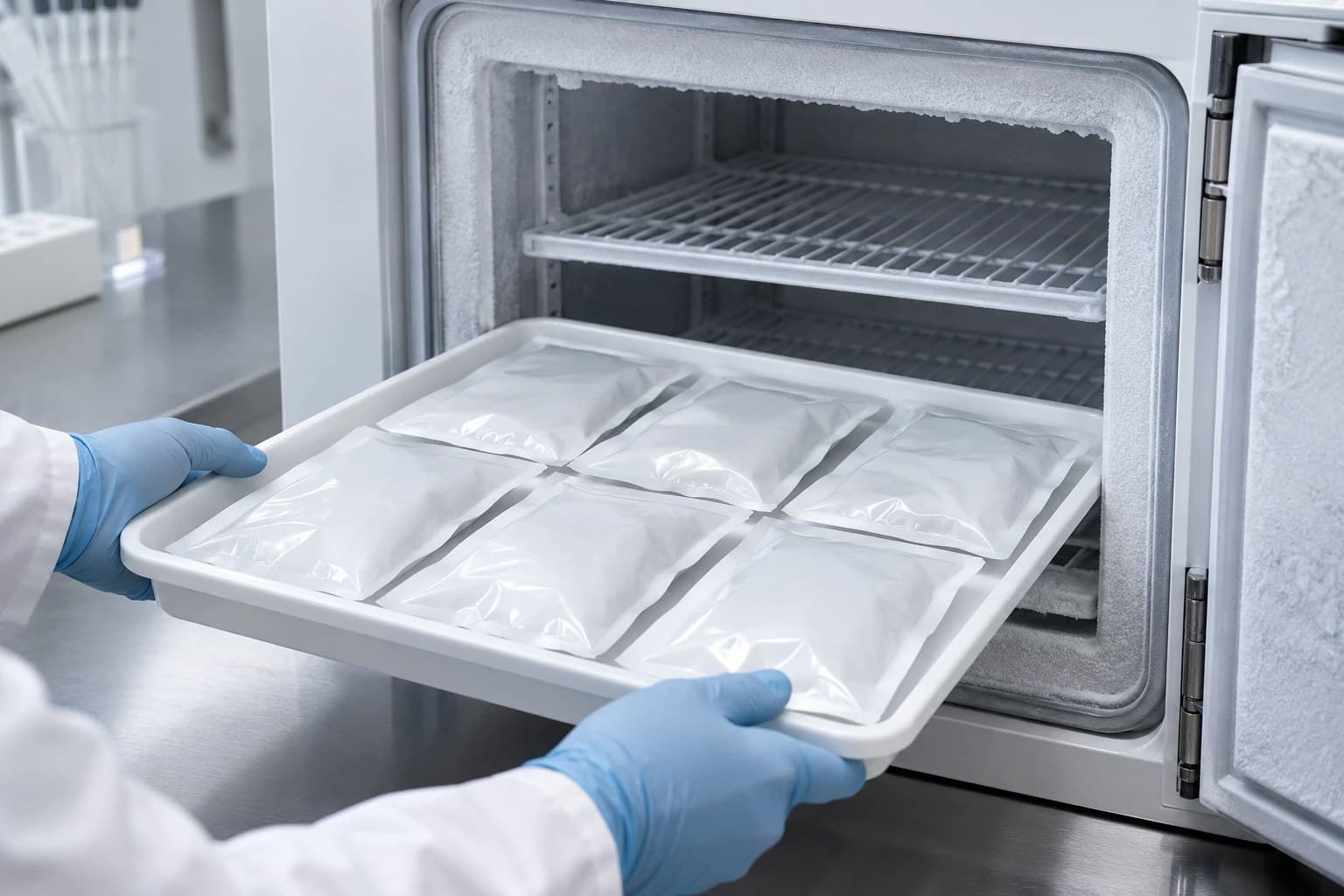
Measure seals and check for leaks
Seal strength and leak integrity are related but different. ASTM F88/F88M measures the force involved in separating a prepared seal specimen and identifies the failure mode. That result should not be described as a complete leak test for the bag. [3]
Select an additional integrity method where needed, considering the package, contents and defect risk. Record the test method and conditions with each result. Keep cold-conditioned and room-temperature results identifiable rather than merging them into one unexplained number.
Assess cold handling and transport
Inspect filled packs after relevant impacts, compression, abrasion or other handling defined in the plan. Examine corners, folds, panels and seals, then assess the pack in its carton or shipping arrangement.
Select a distribution assessment that matches the actual route. ISTA provides different procedures for different shipment systems; a parcel-delivery procedure is not automatically appropriate for a palletized frozen export load. [4]
Confirm product quality separately
Packaging trials should include appropriate product-quality endpoints defined by the food manufacturer. Appearance, texture and other relevant measurements should be reviewed over the intended storage period under the agreed conditions.
Do not derive a shelf-life guarantee from a film data sheet or a brief drop test. Any validated claim must relate to the actual food, process, package and storage conditions. Cold-chain and food-safety responsibilities remain with the appropriate qualified teams.
8. Use Failure Evidence to Guide Improvements
| Observation | What to investigate first | Possible next action to evaluate |
|---|---|---|
| Top-seal leakage | Product contamination, wrinkles and sealing conditions | Improve filling clearance and repeat the seal trial |
| Holes near hard product edges | Product orientation, contact pressure and structure | Compare a justified alternative and handling arrangement |
| Damage along folds | Geometry, material behavior and forming history | Review dimensions and conditioned samples |
| Damage after carton handling | Pack-out, compression and contact points | Revise the shipping configuration and retest |
| Unreliable zipper use | Product obstruction, component position and cold handling | Trial an adjusted closure layout |
These are investigation routes, not diagnoses from appearance alone. Preserve failed samples and compare them with unaffected packs from the same trial. The aim is to connect the failure to reproducible conditions.
For an illustrative frozen dumpling project, the team might compare the current pouch and a revised construction after the same filling, freezing and carton-handling sequence. If failures remain concentrated at the top seal, the next investigation should include the filling and sealing process. Changing only the panel material may miss the cause. This example describes a development approach, not a reported customer result.
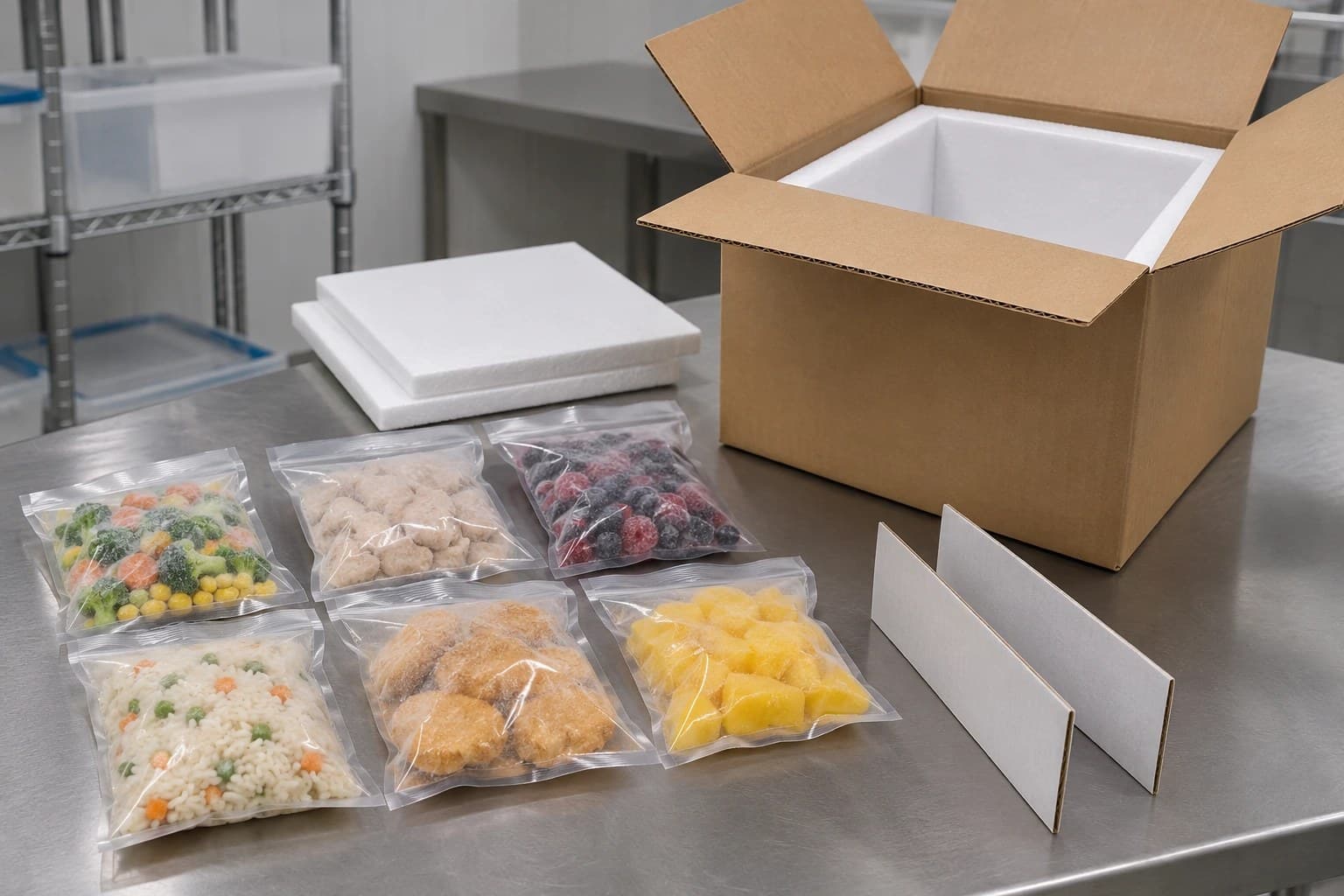
9. Control Shipment Inspection and Repeat Orders
Before shipment, review the signed construction, dimensions, artwork, features, quantities and packing requirements. Confirm that the production lot matches the approved revision and that agreed test records are available.
Keep traceability from material and converting lots to finished cartons. Retain representative samples and record any approved deviation. For repeat orders, require review of changes that could affect sealing, mechanical behavior or intended food-contact use.
Empty pouches also need an agreed storage and handling instruction before use. Ask the supplier how to protect them from damage and unsuitable conditions and how long the recommendation applies. Uncontrolled storage before filling can complicate an otherwise careful approval process.
Turn trial evidence into a purchase specification
An approval file should identify the exact sample revision tested, the product used, conditioning conditions, equipment settings and acceptance criteria. Record which results support each requirement and which checks remain the responsibility of the food producer or its laboratory.
For multiple products sharing a bag construction, document why the trial represents them. Differences in piece shape, fill weight, oil content or filling sequence may require additional assessment. A successful smooth-product trial should not be extended automatically to a sharper or heavier product.
Review the first production run against the trial record. If the commercial setup differs, decide whether further verification is needed before release. This closes the gap between a promising development sample and the packaging actually delivered for daily production, and gives the purchasing team a clear reference when evaluating later substitutions.
Frequently Asked Questions
Can any food-grade bag be used for frozen food?
No. Food-contact suitability and frozen-use performance are different requirements. Confirm documentation for the intended use, then validate cold-condition handling, seals and the filled package under the required conditions.
Does a thicker bag always prevent punctures?
No. Thickness is only one variable. Product shape, structure, contact pressure, handling and bag geometry also matter. Investigate the failure and test a justified construction rather than increasing gauge without evidence.
Can a resealable pouch go directly into a microwave?
Only when the complete package is specifically designed and validated for the stated heating conditions and instructions. A bag approved for frozen storage should not be assumed suitable for microwave or other cooking use.
Why should samples be tested while cold?
The intended handling conditions are part of the application. A room-temperature check alone may not reveal the same behavior as a filled, conditioned package. Define the conditioning and test timing so results can be interpreted and repeated.
What information is needed for a frozen-food bag quotation?
Provide the food type, product shape, fill weight, filling sequence, storage requirements, bag format, closure, quantity per design and destination. Include equipment limits and known failures from the current package when available.
Conclusion
Effective frozen food packaging selection connects the food, film, bag construction, filling process and cold-chain handling. There is no universal thickness or material label that replaces that work.
Develop a written specification, run representative filled-pack trials and retain the approval evidence. This gives procurement, the supplier and the food producer a shared basis for production release and repeat orders.
Discuss Your Frozen Food Packaging Requirements
Explore FULL PACKING’s frozen food packaging application page. Send your product details, pack weight, storage requirements, filling method and expected order quantity to discuss candidate structures and sample preparation. Get a Quote
Technical References
[1] University of Missouri Extension: Freezing Basics.
[2] Amcor: Forming Films.
[3] ASTM F88/F88M: Seal Strength of Flexible Barrier Materials.
[4] ISTA: Test Procedures.