

Introduction
A roasted almond, a soft dried apricot and a fruit-and-nut mix may sit in the same supermarket aisle, but they do not present the same packaging problem. They differ in fat content, texture, moisture behavior, shape and sensitivity to storage conditions. Choosing a pouch because it resembles a competing product can leave important requirements unanswered.
For an overseas buyer, the challenge extends beyond the retail shelf. The package must work with the filling process, survive distribution, present the product clearly and support an evidence-based shelf-life target. The supplier also needs enough information to quote a structure that is practical to manufacture and approve.
This guide explains how to build that specification, compare material options and organize sample testing before ordering custom nut packaging bags or dried fruit pouches.
Quick Answer: What Is the Best Packaging for Nuts and Dried Fruit?
The best packaging matches the product’s main quality risks, filling process and distribution conditions. Nuts often require attention to oxygen exposure and moisture; dried fruit needs moisture control appropriate to its intended texture. Select the laminate, seals and closure together, then validate the filled package. No material name alone establishes shelf life.
Start with five decisions: what is being packed, how it is processed, how much goes into each pack, how the pack is filled and how it will be stored. These answers narrow the options more effectively than asking for the strongest or thickest available bag.
1. Define the Product Before Choosing the Pouch
Separate nuts, dried fruit and mixed products
The Almond Board of California identifies the product, storage environment and package as interacting influences on almond shelf life. Its guidance also distinguishes the protection requirements of roasted, cut and in-shell almonds. That distinction is a useful reminder to specify the actual product rather than the broad category “nuts.” [1]
For dried fruit, describe the desired eating texture. A soft fruit snack and a crisp freeze-dried fruit piece should not share a packaging specification simply because both contain fruit. State whether the product is sliced, sticky, sugar-coated, oil-treated or especially vulnerable to crushing.
Mixed packs introduce another variable: ingredients can behave differently inside the same sealed space. A moisture barrier limits exchange with the outside environment, but it does not stop moisture moving between ingredients. Product formulation and conditioning may need attention alongside the package.
Write a usable application brief
Include the ingredient description, processing state, target fill weight, approximate bulk density, filling temperature and intended unopened storage conditions. Identify any gas flushing or oxygen absorber proposed by the food manufacturer. These are parts of a validated food-packaging system, not features that a pouch supplier should add casually.
Also describe the sales channel. A pouch sold quickly through a local shop faces a different journey from a product held in a warehouse, exported by sea and displayed under bright retail lighting. Request a recommendation for that journey rather than a generic export-grade bag.
2. Translate Product Risks into Measurable Requirements
Oxygen, moisture and light perform different roles
Ask the food development team what ends the product’s acceptable life: flavor deterioration, loss of crunch, hardening, discoloration, sticking or another measurable change. The answer determines which protective properties matter most. Packaging should respond to a defined failure mechanism rather than accumulate layers without purpose.
Amcor’s technical discussion of nuts and dried fruit highlights oxygen sensitivity in fatty nuts and the importance of water-vapor control for dried-fruit texture. It also notes the added complexity of combining the two. These are starting considerations; the required protection still depends on the specific recipe and storage plan. [2]
Light protection is another separate decision. An opaque pouch may support a sensitive product, but opacity does not automatically establish an oxygen or moisture barrier. Likewise, a transparent material may have specialized barrier properties that cannot be judged by looking through it.
Read barrier data with its test conditions
Oxygen transmission rate, or OTR, and water-vapor transmission rate, or WVTR, describe different properties. Request the method, temperature, humidity, units and tested construction with each result. A number without those details is difficult to compare responsibly.
ASTM D3985 and ASTM F1249 are examples of methods associated with oxygen and water-vapor transmission measurements respectively. The ASTM primary-barrier-packaging overview lists both. A test report should identify the applicable method and conditions rather than simply use the phrase “ASTM tested.” [3]
Do not prescribe one universal OTR or WVTR value for every nut or fruit product. Establish candidate requirements with the food technologist and packaging specialist, then confirm whether they deliver the intended quality in filled-pack studies.
3. Compare Complete Structures, Not Material Labels
| Candidate direction | Why a buyer might consider it | What still needs confirmation |
|---|---|---|
| Transparent laminate | Product visibility and printed presentation | Actual barrier, light exposure and product compatibility |
| Metallized laminate | A combination of opacity and barrier functions | Supplied film performance, converting effects and seal integrity |
| Aluminum-foil laminate | A candidate when demanding light and barrier protection is needed | Foil condition, flex damage, seals and filled-pack performance |
| Paper-look laminate | A particular brand appearance and tactile effect | Functional inner layers, moisture behavior and environmental claims |
| Mono-material direction | A project seeking simpler material composition | Required performance, processing and acceptance in the intended recycling system |
This table is a screening tool, not a list of interchangeable specifications. Two laminates with similar names can differ in layer thickness, coatings, sealants and conversion history. Ask the supplier to identify what each layer contributes and which properties will be verified.
Avoid choosing on total thickness alone. A thicker pouch can still miss the required barrier or behave poorly at the filling line. Conversely, reducing thickness without considering puncture, handling and seals may create a saving on paper that fails during distribution.
The final approval document should describe the agreed construction or performance specification, dimensional tolerances, features and evidence required. Where proprietary constructions are involved, agree on an adequate documented performance and change-control basis.
4. Decide Whether a Clear Window Fits the Product
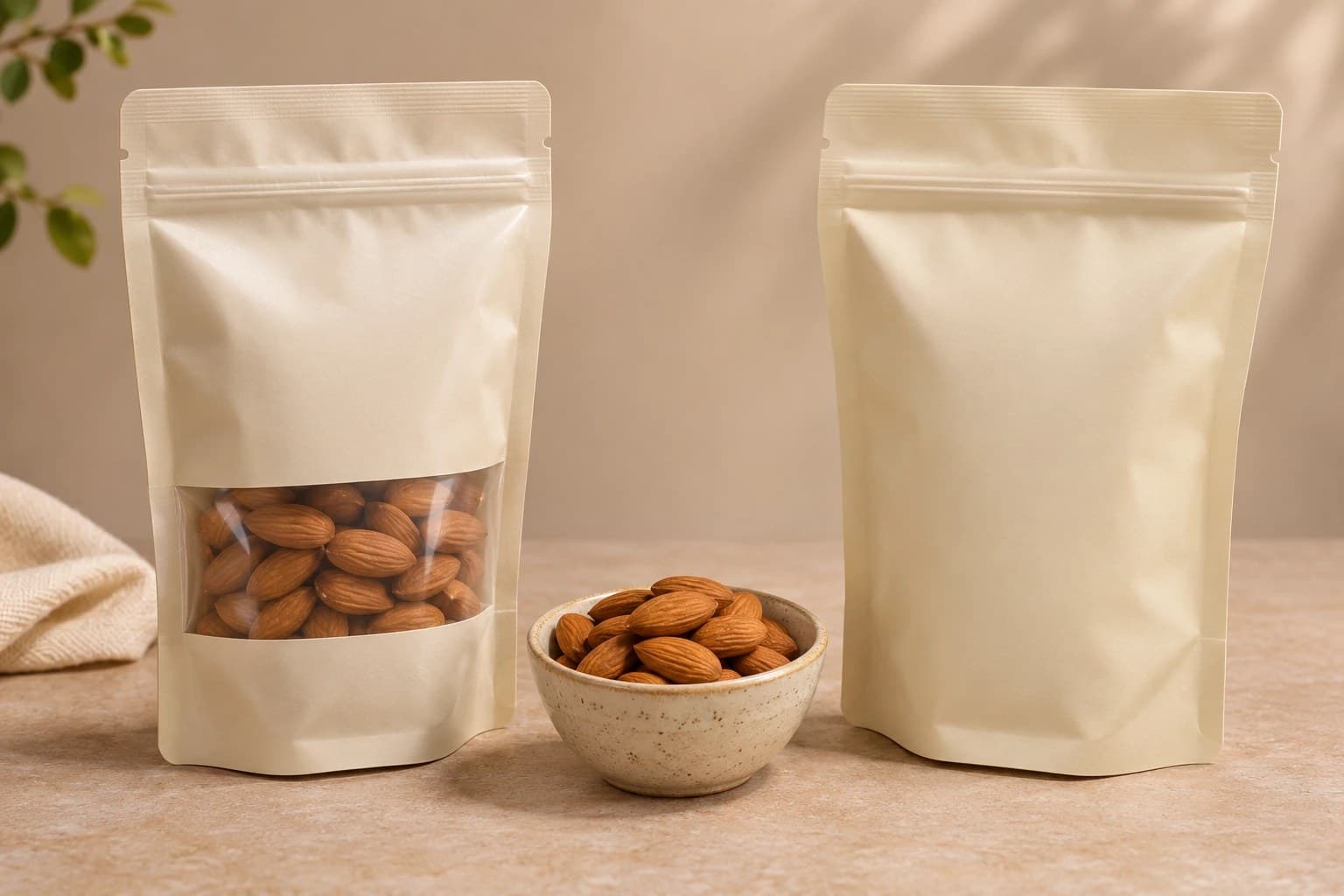
A window can help shoppers assess size, color and ingredient appearance. Its value should be weighed against protection requirements and the planned lighting exposure. The right question is whether the finished windowed pouch meets the application, not whether windows are always good or bad.
Ask how the window is constructed. A clear area created by leaving ink off a transparent laminate is different from removing or changing a functional barrier layer. Obtain the actual specification rather than infer construction from the artwork.
If visibility is commercially important, compare two candidates using the same product and storage conditions: the proposed windowed pack and a suitable opaque reference. Review appearance, flavor, texture and package integrity at agreed intervals. Document the commercial benefit of the window alongside the performance result.
5. Match Bag Format and Closure to Use
Select the format around filling and display
A stand-up pouch can be a starting option for resealable retail packs. A flat-bottom bag may suit a project needing a more structured footprint and additional artwork panels. A three-side-seal pouch may fit portion packs where standing display is unnecessary. None of these formats establishes protection independently of the laminate and seals.
Use real product to confirm dimensions. Equal weights of whole nuts, chopped pieces and dried fruit can occupy different volumes. Allow usable space for filling, zipper engagement and the final top seal; nominal external dimensions are not the same as usable internal capacity.
Treat the zipper and top seal separately
A resealable zipper helps the consumer close the pack after opening. It should not be assumed to provide the same barrier or integrity as the unopened heat-sealed package. Define the original closure and the expected consumer use separately.
Check whether particles collect in the zipper track and whether the opening is convenient for pouring or hand access. Place tear features so the customer can open the package without cutting away the zipper. These details are easier to correct during sampling than after printed production.
6. Prepare the Filling Trial Before Approving Artwork
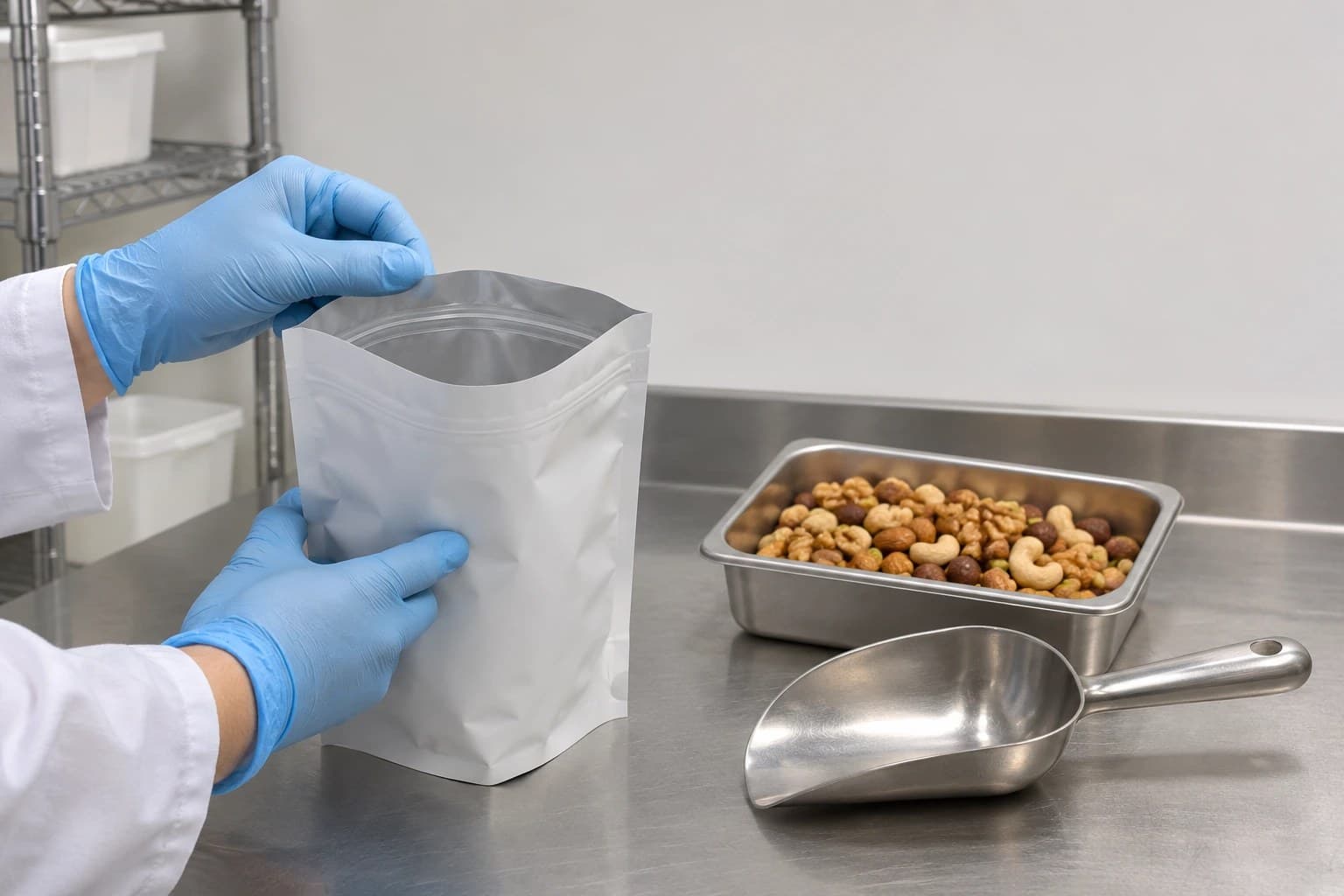
The actual filling conditions can expose problems that an empty sample hides. Oily pieces, fine seasoning and sticky fruit can contaminate the seal area. An awkward opening can slow manual filling or interfere with an automated gripper.
Ask the packing team to define the sample quantity needed for setup, steady running and inspection. Record the equipment identification, material revision, seal temperature, dwell time, pressure and line speed where relevant. Use the equipment manufacturer’s guidance when establishing a safe process window.
If gas flushing is part of the project, evaluate it as a controlled filling operation. Define how residual oxygen will be measured, when measurements occur and what acceptance criteria apply. A film barrier cannot compensate for an unsuitable filling atmosphere or an incomplete seal.
Keep unsuccessful trial packs as well as successful ones. A photo of a wrinkle, contamination point or filling obstruction gives the supplier a concrete issue to investigate. Change one controlled variable at a time so the next trial produces usable information.
7. Use a Staged Sample-Approval Plan
Stage A: Fit and handling
Fill size samples with representative product. Check capacity, opening access, standing behavior, pouring, zipper use and carton fit. Photograph the filled pack from the front, side and base using a consistent setup. Record dimensions and the sample revision.
Stage B: Seals and package integrity
Agree on tests suitable for the risk. Visual inspection, seal-strength measurement and an appropriate leak method answer different questions. ASTM F88/F88M addresses seal strength; it should not be represented as proof that an entire pouch is leak-free. [4]
Confirm specimen preparation, conditioning, sampling locations and acceptance criteria with the testing party. Do not replace a documented method with an informal squeeze demonstration and describe the two as equivalent.
Stage C: Product quality during storage
Build the study around defined storage conditions and agreed quality endpoints. Include the actual food, target filling process and representative package construction. Keep reference samples and record observations consistently.
Accelerated studies may help development where their relationship to the product is justified. They do not automatically establish real-time shelf life. Any shelf-life statement should belong to the validated product-and-package combination, not to an empty pouch offered in a catalog.
Stage D: Distribution and shipment inspection
Assess the filled pouch within its carton or shipping system. Check abrasion, puncture, crushing and seal damage after relevant handling. Choose a distribution test with the laboratory for the intended route rather than applying a parcel protocol to every export shipment. ISTA distinguishes procedures by distribution environment. [5]
Before shipment, inspect against the signed specification and approved samples. Record lot identification, quantity, print version, dimensions, closure function and agreed performance checks. Retain reference samples so a later complaint can be traced to the correct production lot.
8. Example: Build a Decision Record for a Mixed Snack
Consider an illustrative project containing roasted nuts and soft dried fruit. The buyer wants a resealable retail pack with a viewing window and overseas distribution. This is a planning example, not a reported customer case or a tested FULL PACKING result.
First, list the unresolved issues: ingredient moisture interaction, oxygen sensitivity, window construction and filling contamination. Next, shortlist two documented laminate options and make comparable size samples. Run the actual filling process and reject any geometry that creates unreliable top seals.
Then compare the surviving packs in the product-quality study and distribution assessment. The decision record should explain why one option was selected, which conditions were tested and what remains to be monitored during launch. That record is more useful for a repeat order than a note saying “premium bag approved.”
Keep procurement, food development and production involved in the same approval. Procurement controls the commercial scope, the technical team assesses product protection and production confirms line performance. A supplier recommendation becomes actionable when those responsibilities meet in one written specification.
Keep the specification usable for repeat orders
Build a small approval file containing the final drawing, material or performance requirements, artwork revision, sample photographs and test records. Identify which document governs if a quotation, email and purchase order describe the pack differently. Resolve that conflict before production starts.
For multiple flavors, separate the shared technical specification from the artwork matrix. The same bag size does not mean every recipe has identical protection needs. Review whether oils, seasonings or fruit proportions change the application before combining products into one purchasing program.
Ask how the supplier will communicate changes to films, components or manufacturing arrangements that could affect agreed performance. A successful first order is a reference point, not permission to make unreviewed substitutions. This discipline also helps a distributor explain the approved package consistently to several downstream customers.

Frequently Asked Questions
Do nuts always need aluminum-foil packaging?
No. Foil is one candidate, not a universal requirement. The decision depends on the product, intended storage, filling atmosphere, protection targets and finished-pack validation. Compare suitable constructions on evidence rather than assume the most opaque material is always necessary.
Can dried fruit use the same bag as roasted nuts?
Possibly, but do not assume equivalence. The products may have different texture and oxygen-related requirements. For a mixed product, ingredient interaction also matters. Evaluate the combined recipe in the intended package.
Is a zipper enough to keep an unopened pouch protected?
A zipper is a reclosure feature. The unopened package normally relies on its specified original sealing system. Evaluate the top seal and zipper function separately, and avoid claiming unopened shelf-life performance for repeated consumer opening.
Can you determine pouch dimensions from fill weight alone?
No. Product density, shape, usable internal space and closure position affect fit. Supply product samples or reliable volume information, then confirm the proposed dimensions with a filling trial before approving artwork.
What should an overseas buyer send when requesting a quote?
Send the product description, fill weight, market, storage conditions, shelf-life target, filling method, preferred format, quantity per design and delivery destination. Identify any requirements still undecided so the supplier can separate assumptions from confirmed specifications.
Conclusion
Choosing packaging for nuts and dried fruit starts with the food and ends with a verified filled package. Material names, thickness and appearance help describe an option, but they do not replace product-specific requirements, filling trials or shelf-life evidence.
Use one controlled specification from sampling through shipment inspection. This gives the buyer, converter and filling team a common basis for deciding whether the package is ready for commercial production.
Discuss Your Nut or Dried Fruit Packaging Project
Explore FULL PACKING’s food and snack packaging options, or send your product, target pack size, quantity and destination for a project discussion. If the structure is still open, describe the performance you need and request suitable samples before finalizing the order. Get a Quote
Technical References
[1] Almond Board of California: Shelf Stability and Shelf Life.
[2] Amcor: How to Choose Barrier Packaging for Nuts and Dried Fruits.
[3] ASTM Committee F02: Primary Barrier Packaging overview.
[4] ASTM F88/F88M: Seal Strength of Flexible Barrier Materials.
[5] ISTA: Test Procedures.