
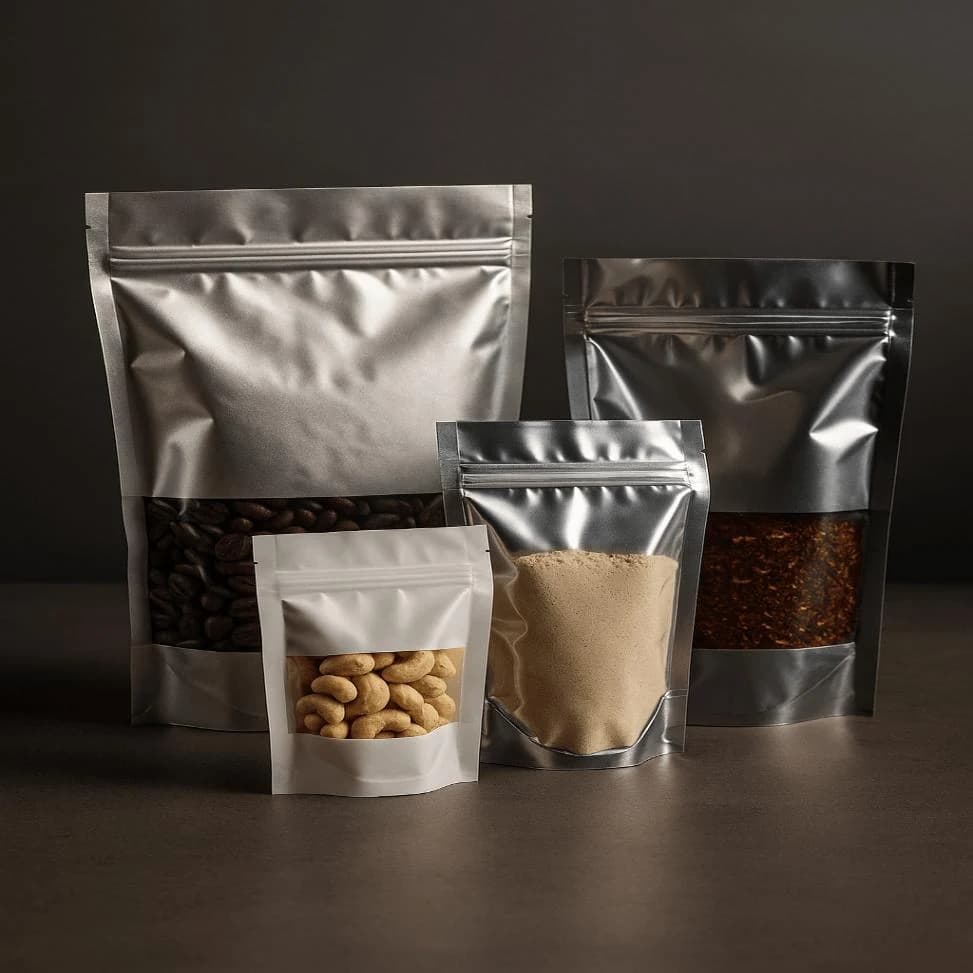
Aluminum foil and VMPET are different barrier materials used in flexible food packaging. Intact foil provides a very high barrier to gases, moisture and light; VMPET offers a metallized-film option whose performance depends on its grade and processing.
While both help protect the contents from external factors such as oxygen, moisture, and light, they are not identical materials.
Choose between them by defining the protection your product needs, then comparing finished-laminate data, handling performance and total packaging cost.
What is aluminum foil
Aluminum foil is a metallic material often used as a high-barrier layer in food packaging.
An intact aluminum foil layer provides a very high barrier to oxygen, moisture and light. A finished foil pouch can still lose protection through poor seals, pinholes or damage, so foil does not make package testing unnecessary.
Foil laminates can be considered when a food needs demanding protection targets, but the whole structure must remain suitable for filling, handling and distribution.
Products such as coffee, nuts, powdered foods, and items requiring long shelf lives often utilize packaging structures that incorporate aluminum foil.
What is VMPET
VMPET stands for metallized PET film (vacuum-metallized PET).
It is created by depositing a very thin layer of aluminum onto the surface of a PET film; thus, it combines the characteristics of PET film with specific barrier and light-blocking capabilities.
The deposited aluminum layer is much thinner than a foil sheet. This does not mean that every VMPET laminate is thinner, lighter or more flexible than every foil laminate: total thickness and handling depend on all layers.
What are the differences between aluminum foil and VMPET
One of the most obvious differences lies in their structure.
Aluminum foil is a solid sheet of metal, whereas VMPET consists of a PET film with a vacuum-deposited aluminum coating.
As a result, they differ in terms of barrier performance, flexibility, processability, and cost.
Foil is often considered for demanding gas, moisture and light protection. Its suitability also depends on the selected thickness and the integrity of the finished pack.
A VMPET laminate can be a practical choice when its measured barrier meets the product’s requirements. Metallized films cover a range of performance levels, so compare specific grades rather than assuming one fixed ranking.
Which material is better for coffee packaging
Coffee has stringent packaging requirements because it is easily affected by oxygen, moisture, and light.
Therefore, coffee packaging generally requires high barrier performance.
Either a suitable foil laminate or VMPET laminate may be considered for coffee packaging. Freshly roasted coffee that is packed while it continues to release carbon dioxide often needs a one-way degassing valve. A valve is not automatically required for every coffee product, such as instant coffee; the decision depends on the product and packing process.
Evaluate the complete coffee bag, including seals, any valve or zipper, headspace management and storage conditions. Barrier layers and nitrogen flushing, where used, do not replace shelf-life validation.
Which material is more cost-effective
Compare quotations for the same bag size, quantity, printing, closure, performance target and delivery terms. Material grade, total laminate thickness, converting requirements and order size all affect the result.
VMPET can be cost-effective in some applications, but there is no universal price rule. Choosing a cheaper structure that misses the protection target can increase product losses and complaints.
Conversely, adding a more demanding barrier structure may not be useful if a validated alternative already meets the shelf-life and handling requirements.
Selecting the right material based on actual product needs is usually more effective for controlling packaging costs.
What else should be considered
Review seal strength, puncture resistance, flex durability, filling compatibility and light protection alongside barrier data. Ask whether reported values refer to a single film, a laminate or the finished pack.
For instance, if a product requires long-distance transport and high packaging strength, the overall composite structure must be considered, rather than focusing on a single barrier material.
A shorter sales cycle does not remove the need for suitable packaging. Any lower-barrier option should still be validated for the actual product, climate and distribution route.
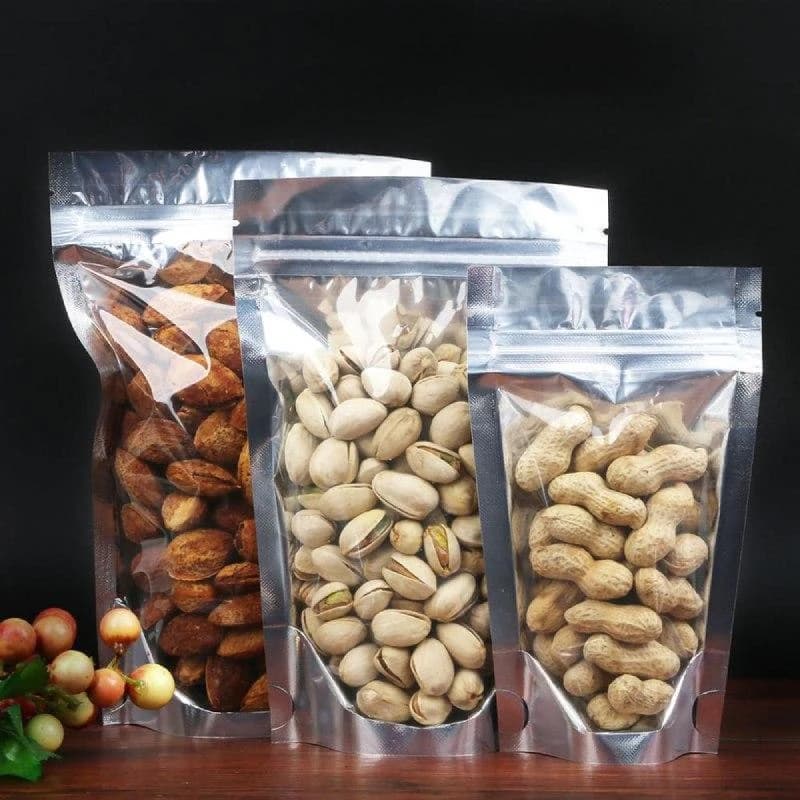
Choosing a suitable structure
Both aluminum foil and VMPET are common barrier materials in food packaging, yet they are suited to different applications.
Foil can provide very high barrier protection, while VMPET can meet many food packaging needs with a metallized-film structure. Neither choice guarantees finished-bag performance without suitable converting and seals.
Set measurable protection targets, compare suitable samples and verify the packaging with the actual food before committing to production.
Frequently asked questions
Is every silver pouch an aluminum foil pouch
No. A silver surface may come from foil, VMPET or another metallized film. Ask for the full layer structure.
Is VMPET always cheaper than foil
No. Compare equivalent bags and the same protection target; the full specification and order quantity determine the quotation.
Choosing a barrier bag for coffee, nuts, snacks or powders? Send FULL PACKING your pack size, product details, target shelf life, filling method and quantity. Our team can discuss foil and metallized-film options around your project requirements.