
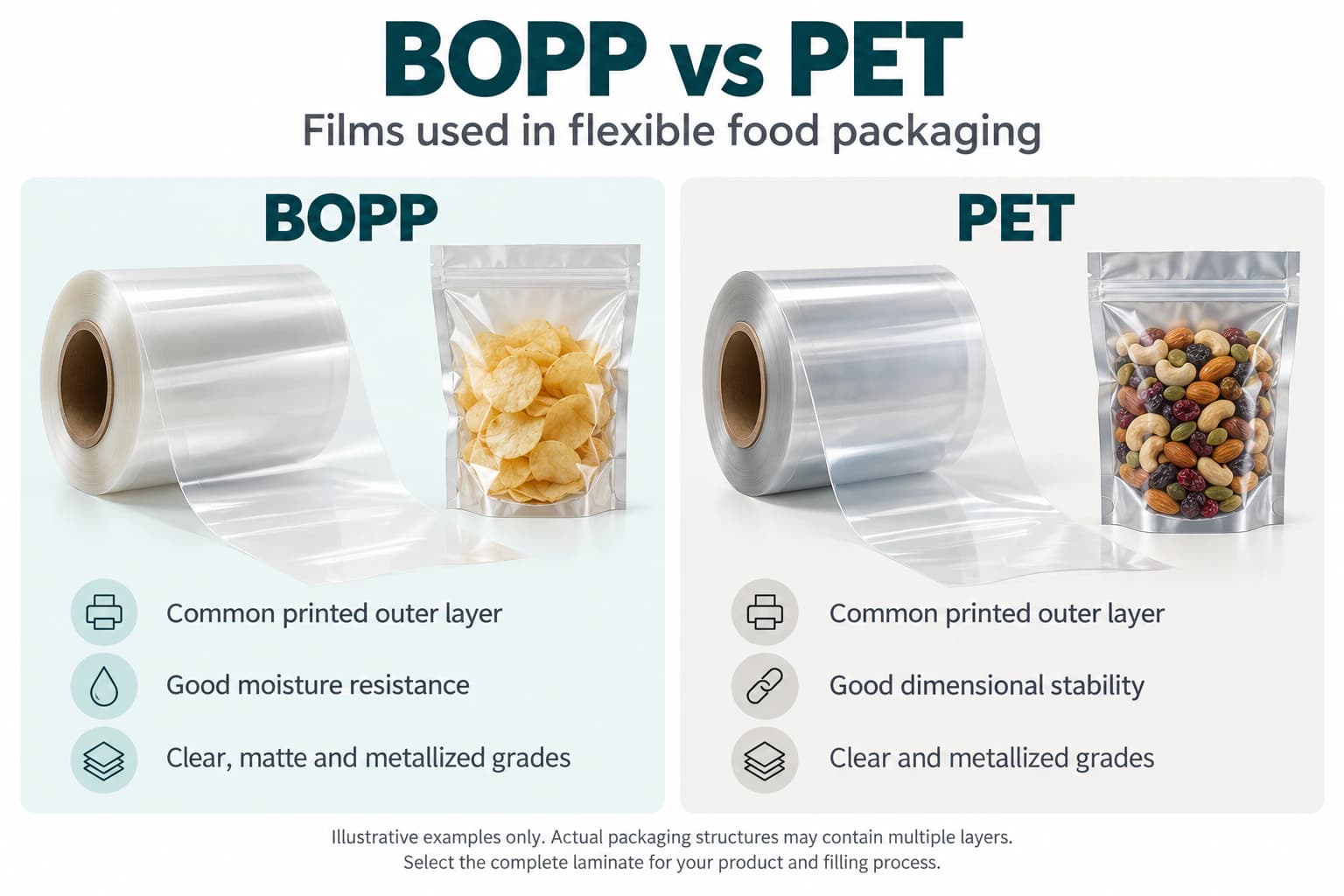
BOPP and PET are widely used in flexible food packaging, often as layers within a laminated bag. Neither is the best choice for every product: a suitable structure must balance protection, printing, sealing and the filling process.
For many dry snacks, BOPP can be a practical option where moisture protection, appearance and cost matter. PET is commonly selected for printed laminates where dimensional stability during converting is important. The final choice should be based on film grades and finished-pack performance, rather than the polymer name alone.
What is BOPP
BOPP stands for Biaxially Oriented Polypropylene; it offers excellent transparency, gloss, and printability.
Clear grades of BOPP can provide good transparency and gloss. Matte, white, coated and metallized grades are also available, so BOPP does not describe one fixed appearance or barrier level.
Consequently, BOPP is frequently used for packaging items such as potato chips, candy, cookies, puffed snacks, and other treats.
BOPP can contribute stiffness and moisture resistance. The bag shape and ability to stand upright also depend on its thickness, other layers, gussets and base design.
What is PET
PET stands for Polyethylene Terephthalate; it is also widely used in flexible food packaging.
Oriented PET packaging film is valued for mechanical properties and dimensional stability, including during printing and lamination. Its performance depends on the selected grade and thickness.
PET also offers good printability and is used in laminates for snacks, coffee, nuts and other foods. Clear PET alone should not be treated as a complete high-barrier packaging solution.
What are the differences between BOPP and PET
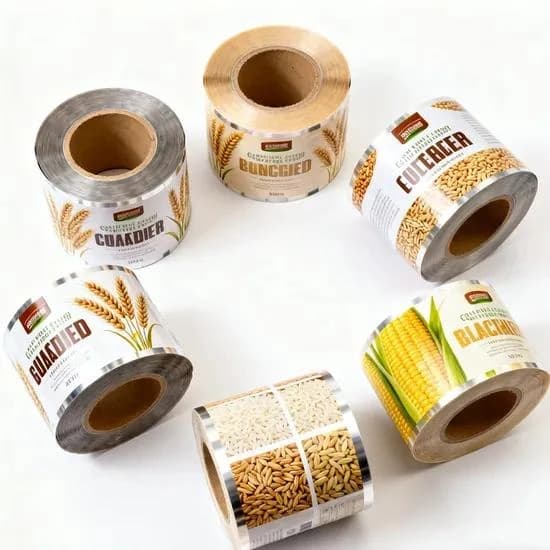
Both films can provide attractive printed surfaces. BOPP is often chosen for dry-snack structures and moisture protection; PET is often chosen for the stability of a printed outer layer. These are typical uses, not rules that apply to every grade.
For shelf appeal, compare the actual finish, transparency, print quality and sample bag. PET can also be clear and glossy, and BOPP can have a matte or opaque finish.
For transport durability, compare the complete laminate and finished bag. Puncture resistance, seal strength and resistance to repeated flexing cannot be predicted from the outer film alone.
However, this does not mean that BOPP is inherently better than PET, or vice versa.
The choice of food packaging material should be based on the specific product.
How should you choose for different types of food
Chips, cookies and puffed snacks may need both moisture protection and protection against oxidation, particularly when they contain fats. BOPP is one possible outer film; a suitable barrier and sealant layer must be selected around the product.
Coffee and nuts can require oxygen, moisture and light protection. Establish the target shelf life, storage conditions and packing method before specifying a multilayer structure.
Illustrative structures include BOPP/CPP for some dry foods, BOPP/metallized BOPP for some snacks, and PET/VMPET/PE for products needing a metallized barrier. These examples are starting points for evaluation, not universal recommendations.
How do BOPP and PET fit into a laminate
Each layer has a role, and the outer film is only one part of the design.
BOPP or PET may provide the printed outer surface, while another layer supplies the required barrier or sealing function. Multiple PET-based layers can also appear in one structure, such as PET/VMPET/PE.
PE and CPP are common sealant choices, depending on the structure and filling requirements. Some BOPP and PET grades have sealable surfaces, but standard outer films should not automatically be assumed to seal on the customer’s equipment.
Therefore, when selecting materials, one must consider the overall structure of the finished package rather than focusing solely on the properties of a single film.
What else should be considered when selecting materials
Specify the food type, net weight, bag dimensions, filling equipment, target shelf life, storage environment, transport conditions and order quantity. Also confirm whether the bag needs a zipper, window, valve or other fitment.
Ask for oxygen transmission rate (OTR) and water vapor transmission rate (WVTR) data where relevant. Compare values only when test conditions, units and the tested material are comparable; a film data sheet is not a guarantee of finished-bag performance.
Review samples for sealing and handling performance, and validate shelf life with the actual food and packing process. Confirm food-contact documentation for the intended market and use; a polymer name by itself does not establish compliance.
Choosing a suitable structure
Both BOPP and PET are widely used materials in flexible food packaging, yet they possess distinct characteristics.
BOPP and PET both have useful roles in food packaging. Choose a structure using product protection targets and actual film specifications, then verify the finished bag rather than relying on a simple ranking of the two materials.
The best outer film is the one that works with the barrier layer, sealant, filling equipment and distribution conditions of your project.
Frequently asked questions
Is PET always better than BOPP
No. The answer depends on the specific grades, laminate design, filling process and protection target. Compare finished-pack performance.
Can clear BOPP or PET replace a barrier layer
Only if the proposed structure meets the actual product requirements. Clear appearance and good printing do not establish adequate oxygen or moisture protection.
Planning custom food packaging bags? Send FULL PACKING your product type, pack weight, target shelf life, filling method and estimated quantity. Our team can discuss suitable bag formats and material options for your project.