
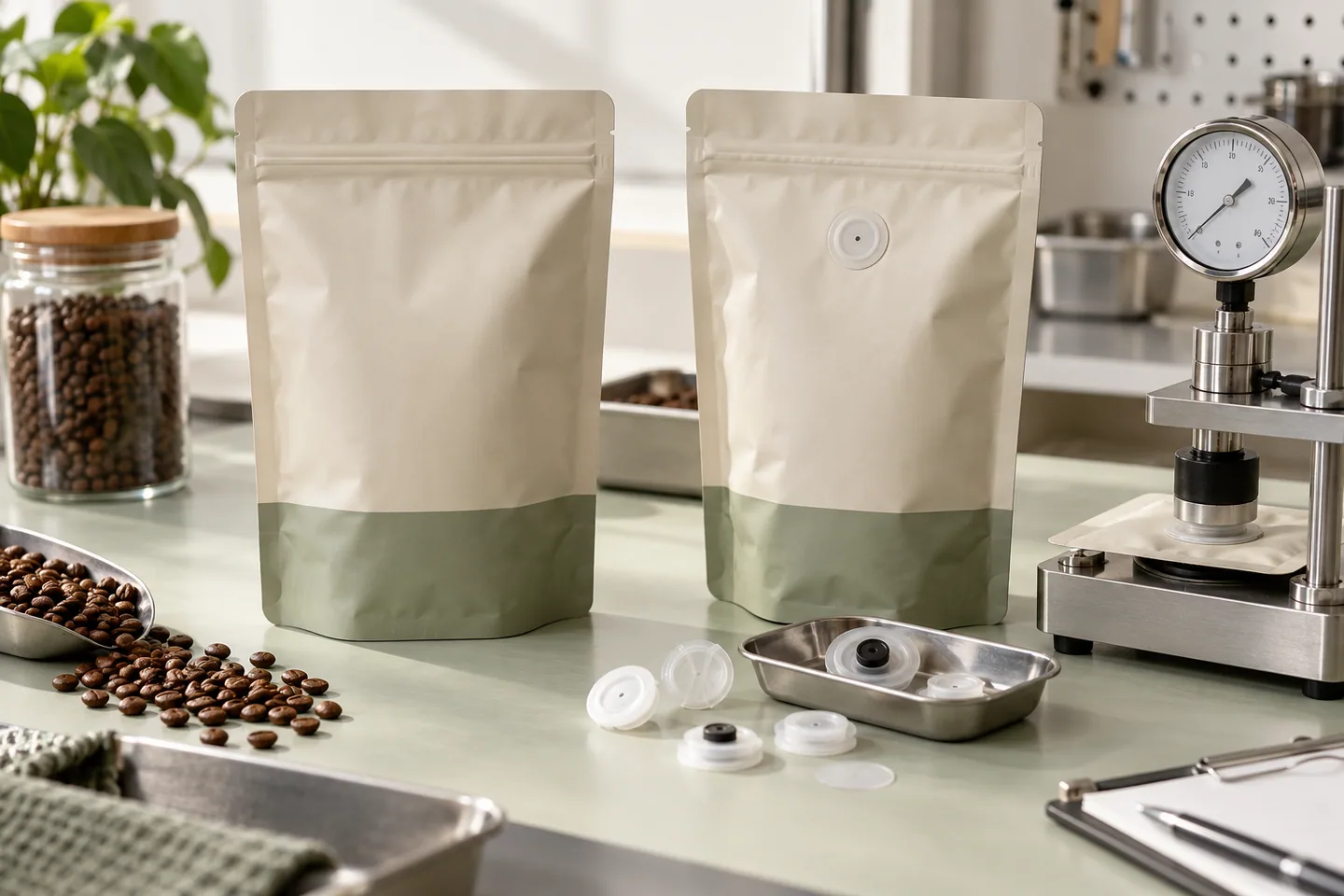
A one-way coffee valve is designed to release gas from inside a package while limiting gas entry from outside. It can be useful for freshly roasted coffee that continues to release carbon dioxide after packing, but not every coffee bag needs one. The decision depends on roast profile, time between roasting and filling, whole-bean or ground format, target shelf life, package barrier, filling process and distribution plan.
The valve is one component of a system. Film structure, valve attachment, zipper, final top seal and storage conditions still control package performance. A valve cannot compensate for a leaking seal, unsuitable barrier or uncontrolled filling process.
Why Freshly Roasted Coffee Releases Gas
Roasting creates gases within the coffee structure. Release continues after roasting, with the pattern influenced by roast, bean, grinding, cooling, storage and time. If coffee is packed while gas release is still significant, internal pressure can make a sealed bag swell. Waiting longer before packing may reduce pressure but can increase exposure to oxygen and aroma loss.
A one-way valve offers one possible balance: pack sooner while allowing pressure to vent. The correct strategy must be validated by the roaster because coffee behavior and logistics differ.
How a One-Way Valve Works
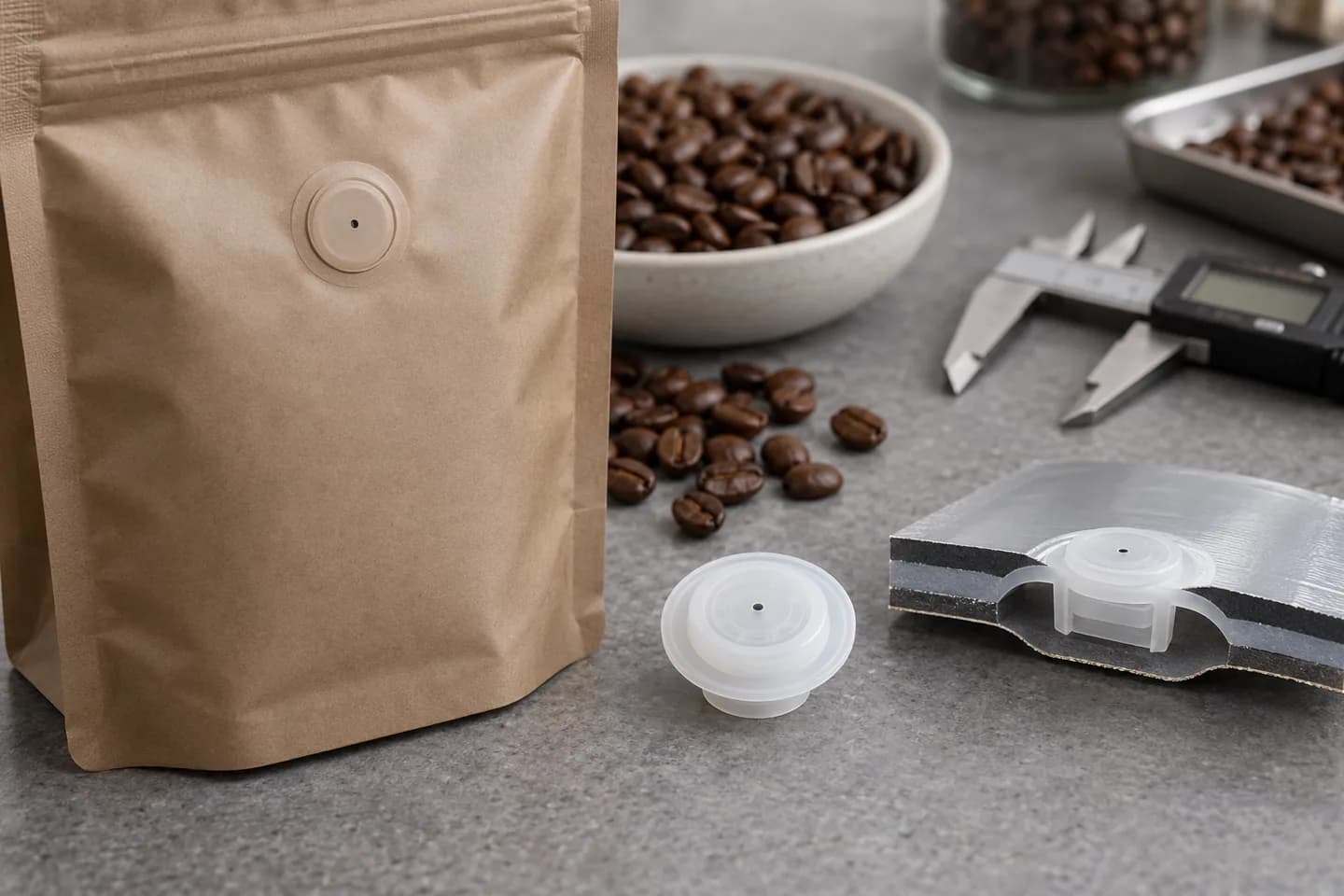
Commercial valves use a controlled pathway that opens when internal pressure reaches the valve’s operating condition and closes as the pressure difference falls. Designs vary. The buyer should confirm valve model, materials, attachment method, operating direction and suitability for the intended pouch and coffee.
“One-way” should not be read as an absolute guarantee of zero oxygen movement. Package oxygen exposure also comes from film transmission, seals, headspace, filling and consumer opening. Evaluate the finished package, not the component name.
Do Whole Beans and Ground Coffee Need the Same Valve Strategy?
No. Grinding increases surface area and changes degassing behavior, oxygen sensitivity and handling. Whole beans may continue releasing gas on a different time curve. The package specification should state product form, roast level, time from roast to pack, fill weight and expected storage.
For pre-ground coffee packed after an established resting period, a valve may or may not be appropriate. Some products use vacuum or gas-flush strategies with different package requirements. Avoid copying a competitor bag without understanding the process behind it.
Valve Placement on the Coffee Bag
Placement affects function, appearance and converting. The valve should avoid seals, gusset folds, zipper flanges, artwork-critical areas and locations likely to be blocked by product. The final position must be dimensioned from stable pouch edges on the approved drawing.
Review the filled bag. A valve placed correctly on a flat dieline may sit near a fold or product surface after filling. For flat-bottom and side-gusset formats, panel geometry differs from a stand-up pouch. Placement should also leave room for labels and date codes.
Inside or outside appearance
Some valves are more visible from the exterior than others. If a discreet appearance is important, discuss feasible valve and film routes before artwork. Do not cover a valve with a label or heavy decoration that interferes with function.
Valve Application and Attachment
Valves may be applied during pouch production using equipment suited to the component and film. The attachment area must be clean, correctly positioned and compatible with the laminate. Heat, pressure, punching and adhesive or welding conditions depend on the valve system.
Factory controls can include position checks, attachment appearance and functional sampling. The exact method should be agreed for the project. A valve attached to the wrong layer system can leak around its perimeter even if the valve itself operates correctly.
Barrier Structure Still Matters
Coffee can be sensitive to oxygen, moisture, aroma loss and light depending on product and shelf-life objective. A valve manages internal gas; it does not create the film barrier. The laminate may use clear, metallized or foil-based layers, but selection should follow product and validation needs.
If the brand wants a transparent window, consider the barrier and light trade-off. If a recyclable mono-material direction is requested, valve and laminate compatibility plus local recycling guidance need review. Marketing appearance should not override product protection.
Explore coffee bag formats and materials and barrier options as connected decisions.
Zipper, Valve and Top Seal Must Work Together
The manufacturer’s top seal protects the unopened pack. A zipper supports consumer reclosure after opening but is not normally the original hermetic closure by itself. Reserve enough headspace for filling, zipper operation, tear notch and final seal.
The valve position should not interfere with zipper application or heat-seal jaws. Coffee dust and beans must be controlled in the final seal area. Fill trials should evaluate package swelling, zipper contamination and top-seal consistency together.
Tests for a Valve Coffee Bag
Visual and positional inspection
Confirm valve model, orientation, location and attachment appearance against the drawing. Check multiple samples across the production run.
Attachment integrity
Assess leakage around the valve-to-film interface using a suitable finished-package method. A functional valve can still fail at the attachment perimeter.
Opening and closing behavior
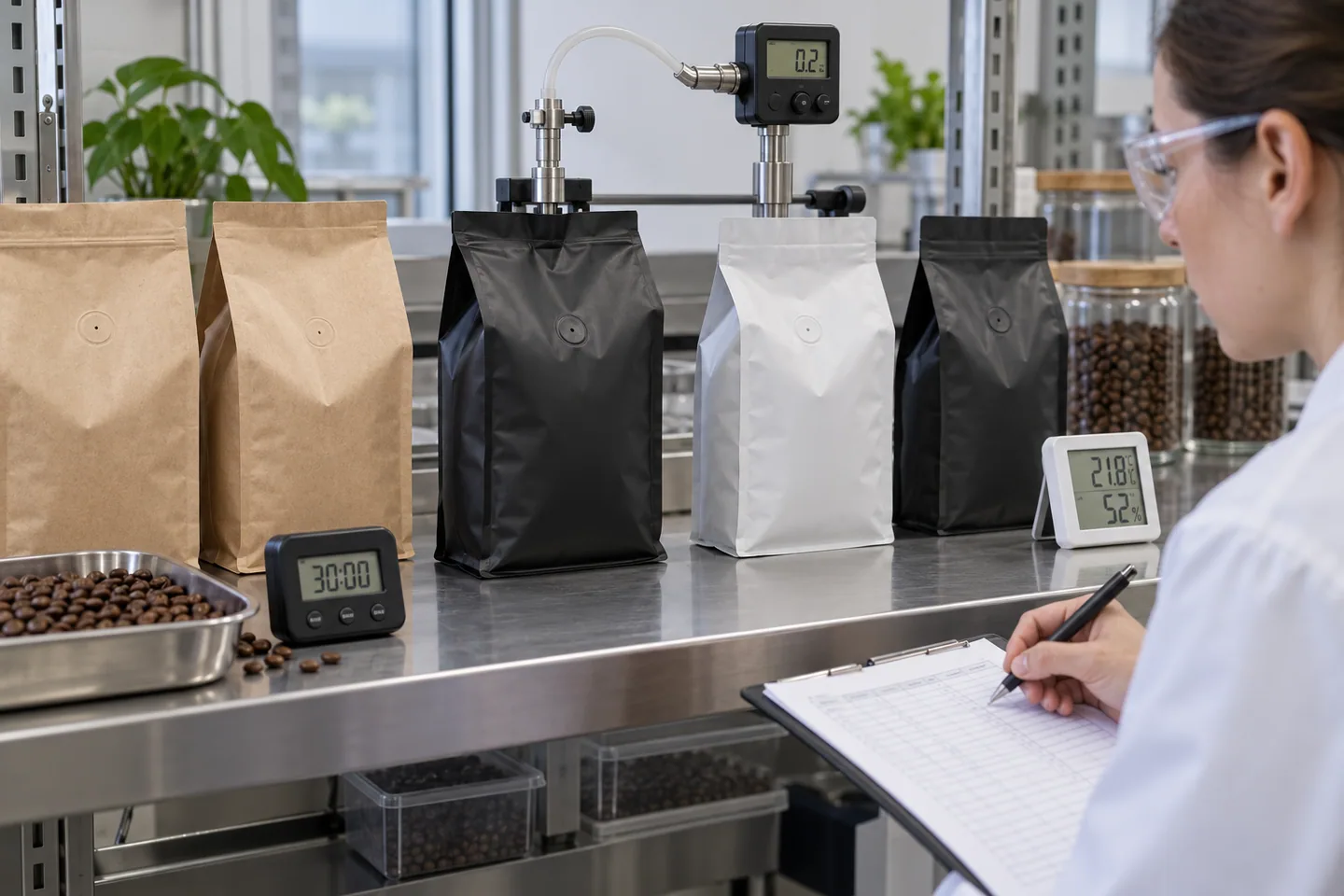
Evaluate the valve under representative internal pressure and storage conditions. The method should match the supplier’s component guidance and the buyer’s risk plan.
Filled-bag observation
Pack representative coffee at the intended time after roast. Monitor swelling, panel stress, seal integrity and pack shape. Record temperature and time because degassing behavior changes.
Oxygen and shelf-life validation
If oxygen exposure or freshness is critical, use a product-package study suited to the target claim. Valve presence alone does not prove a shelf-life result.
Distribution testing
Check filled pouches in their real carton configuration. Altitude and transport conditions can change pressure relationships. Inspect valves, seals and bag appearance after the test.
Common Coffee-Valve Problems
The bag still swells
Possible causes include gas release exceeding the valve’s practical venting behavior, blocked valve location, attachment issue, unsuitable component or time/temperature changes. Verify the product timeline and valve system before altering the bag.
The bag loses aroma or goes stale
Review film barrier, seals, headspace oxygen, filling exposure, valve integrity and storage. Do not assume the valve is the only pathway.
Coffee particles block the valve area
Check valve placement, fill level, package orientation and handling. The solution may involve dimension, placement or process changes.
Valve position varies visually
Confirm the measurement reference and production tolerance. Artwork should provide sufficient clearance so normal controlled variation does not create a visible collision.
What to Include in a Coffee Bag RFQ
- Whole bean or ground coffee
- Roast profile or general roast category
- Time from roasting to filling
- Fill weight and product density
- Target shelf life and storage conditions
- Bag format and dimensions, if known
- Desired valve and zipper
- Filling and sealing equipment
- Finish, artwork and number of SKUs
- Order quantity by size and design
- Destination market and distribution route
This information helps the manufacturer discuss valve need, barrier direction, format and sample plan without claiming one universal coffee-bag structure.
How Gas Flushing Relates to a Degassing Valve
Some coffee packing systems use nitrogen or another controlled gas to reduce oxygen in the headspace. Flushing and degassing solve different problems: flushing addresses the atmosphere present during packing, while a valve manages pressure created after sealing. A project may use both, one or neither.
If flushing is planned, confirm nozzle arrangement, flow, fill speed, pouch opening and final sealing. Measure residual oxygen using an appropriate method rather than assuming a specified gas flow creates the same result in every bag. Valve performance, headspace, film barrier and seal integrity remain relevant after flushing.
Valve Coffee Bags for Different Sales Channels
Retail shelf packs, e-commerce shipments and food-service bags experience different handling. A flat-bottom bag may provide strong shelf presence, while a side-gusset bag may fit case packing efficiently. E-commerce can expose the valve and seals to repeated impact or compression alongside other products.
Review secondary packaging and orientation. Avoid placing hard valve components where they repeatedly rub adjacent packs. For export, consider altitude and temperature changes along the route. The objective is not to design for a theoretical maximum pressure but to represent the actual journey and acceptance risk.
A Practical Coffee-Bag Sample Plan
Use samples in stages:
- Existing format samples to compare size, zipper, finish and valve appearance.
- Unprinted prototypes filled with the intended coffee to confirm volume and valve location.
- Printed mock-ups to review artwork around folds, valve, zipper and regulatory text.
- Production-intent samples where necessary to assess the final material, print and applied valve.
- Filling trials at intended roast-to-pack timing and line settings.
- Storage and distribution samples retained under defined conditions.
Label every sample with structure, dimensions, valve model and date. A pouch approved only for appearance should not be treated as proof of barrier or functional performance.
Sensory and Shelf-Life Considerations
Coffee quality is evaluated through more than package pressure. Aroma, flavor, oxidation and moisture exposure can change over time. Build a study using representative production coffee and realistic storage. Define evaluation intervals, controls and acceptance before the study begins.
Instrumental oxygen or moisture information can complement sensory work, but neither should be interpreted without context. A valve bag that remains flat may still have unsuitable barrier; a bag that swells slightly may not have failed. Connect package observations with product quality.
Procurement Checklist for Valve Coffee Bags
- Approved bag format, dimensions and gusset convention
- Coffee type, roast-to-pack timing and fill weight
- Film structure and stated barrier conditions
- Valve supplier/model and placement tolerance
- Zipper, tear notch and final-seal clearance
- Artwork revision and valve no-print area
- Sample and filling-trial approval status
- Valve attachment and package-integrity checks
- Carton orientation and shipment inspection
- Change-notification requirements for film or valve
Frequently Asked Questions
Do all coffee bags need a degassing valve?
No. Need depends on coffee format, roast, resting time, filling process and package strategy. Validate with representative product.
Can a valve let oxygen into the bag?
A one-way valve is designed to limit inward flow while releasing internal pressure, but the complete package determines oxygen exposure. Review valve and attachment performance, film and seals together.
Where should the valve be placed?
Place it on a suitable panel away from seals, folds, zipper, artwork conflicts and likely product blockage. Confirm the final position on a filled sample.
Can I use a valve with a zipper?
Yes, these features can be combined when the pouch geometry provides adequate space. The unopened pack still requires a controlled top seal.
Does a valve extend coffee shelf life?
It can support a packaging strategy for freshly roasted coffee, but shelf life also depends on oxygen, moisture, light, seals, filling and storage. Validate the claimed period.
Conclusion
A coffee valve should be selected from the roast-to-pack process and validated as part of the finished pouch. Define product, timing, barrier, placement, attachment, closure and test conditions before approving artwork or production.
Send FULL PACKING your coffee type, fill weight, bag preference, roast-to-pack timing and target quantity to discuss a practical coffee-packaging route.