
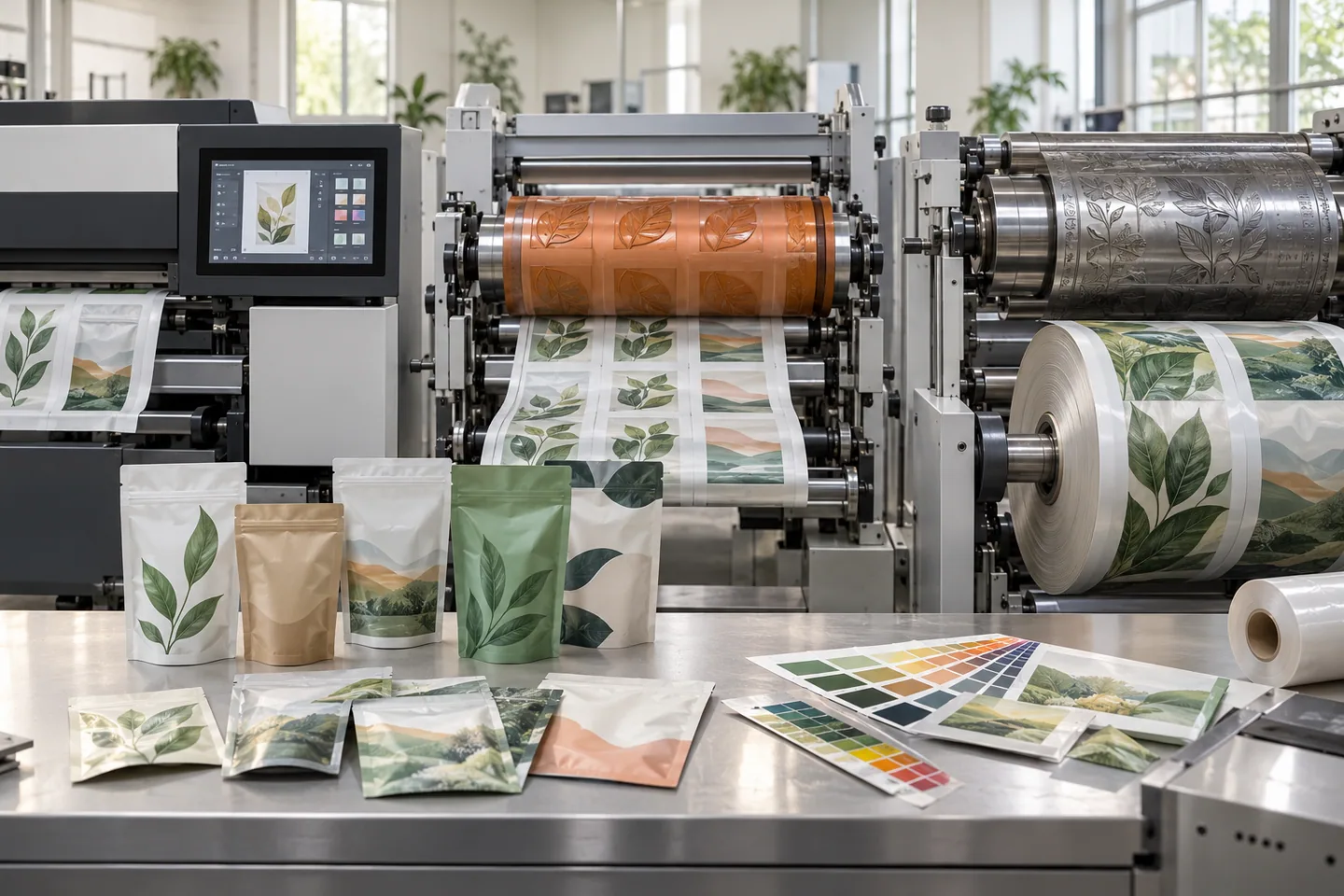
Digital, flexographic and rotogravure printing can all produce professional custom pouches, but they solve different production problems. The best route depends on order volume, number of designs, artwork, film structure, color expectations, repeat-order plan and the converter’s equipment. Digital printing can reduce conventional tooling for selected short runs. Flexography offers broad application flexibility and efficient repeat production. Rotogravure is often considered when long runs and demanding image reproduction justify engraved cylinders.
The print process should not be selected from unit price alone. It affects setup, lead time, minimum practical run, color approval, variable designs and future reorders. This guide shows how buyers can compare the three routes using one consistent brief.
The Short Answer
Choose a print route after answering five questions:
- How many finished pouches or metres of film are required per size and design?
- How many SKUs share the same material, dimensions and finish?
- Does the artwork use process images, fine text, large solid colors, metallic effects or brand-critical spot colors?
- Is the order a market test, regular repeat run or long-term high-volume program?
- Which film and converting process will be used after printing?
No method is universally highest quality or lowest cost. A controlled file, suitable substrate, stable press, correct ink and coating system, experienced operator and agreed approval reference matter in every route.
How Flexible Packaging Printing Fits the Pouch Structure
Many printed pouches use reverse printing: ink is printed on the inner side of a transparent outer film and then protected inside the laminate. Other constructions use surface printing, coatings or paper-like substrates. The choice affects rub resistance, gloss, color appearance, food-contact risk control and finishing.
Printing is only one stage. The web may then be laminated, cured, slit and converted into pouches. Heat, web tension and material movement can affect registration and finished dimensions. Artwork must account for seals, gussets, zipper tracks, valves, spouts, folds and trim.
Digital Printing for Custom Pouches
Digital presses create the image from electronic data without traditional plates or engraved cylinders. This can make digital printing attractive for launches, limited editions, multiple designs and selected lower-volume orders.
Advantages
- Reduced conventional tooling for suitable work
- Efficient design changes between compatible SKUs
- Useful for market testing and artwork validation
- Potential for variable data or versioned graphics where supported
- Shorter setup path for some projects
Limitations to confirm
Digital does not mean every film, size, finish or barrier structure is available. Ask about maximum web and repeat dimensions, white-ink capability, color gamut, spot-color simulation, coating and lamination compatibility, finishing options and repeat-order consistency. Some highly saturated brand colors or special effects may require a different route or a carefully approved compromise.
Digital unit cost may remain higher as volume grows. It can still be commercially sensible if it avoids excess inventory across many SKUs, but compare total usable inventory and version risk—not only cost per pouch.
Flexographic Printing for Pouches and Rollstock
Flexography transfers ink from raised flexible plates through an anilox system to the substrate. Modern flexographic printing can support detailed graphics on a broad range of flexible-packaging applications.
Advantages
- Suitable for many films, papers and coating systems
- Efficient for repeat work and medium-to-large runs
- Good balance of speed, quality and application range
- Spot colors and process work can be controlled with appropriate prepress
Limitations to confirm
Plates and setup influence economics. Very fine highlights, small reverses, gradients and tonal transitions require competent separation, plate and press control. Ask about line-screen expectations, minimum text and line recommendations, trapping, dot gain and how brand colors are measured.
If several SKUs share the same dimensions and structure, determine whether they can be planned efficiently or still require separate plates, setups and production allocations. “Combined quantity” does not automatically mean one uninterrupted print run.
Rotogravure Printing for Custom Pouches
Rotogravure uses engraved cylinders that carry ink in recessed cells. It is widely associated with consistent long-run flexible-packaging production and detailed image reproduction.
Advantages
- Strong repeatability when cylinders, ink and process are controlled
- Capable reproduction of detailed images, fine gradients and dense solids
- Efficient at higher volumes where setup is spread across a long run
- Durable cylinders can support repeat programs when stored and maintained correctly
Limitations to confirm
Engraved cylinders create upfront cost, time and storage questions. Artwork or size changes can require new cylinders. Buyers should clarify cylinder ownership, storage period, maintenance, proofing route and what happens if the converter, design or dimensions change.
Gravure is not automatically the correct choice for every premium design. At low volume or with frequent SKU changes, tooling and inventory exposure may outweigh its production advantages.
Comparison Table
| Decision factor | Digital | Flexographic | Rotogravure |
|---|---|---|---|
| Traditional tooling | Usually no plates/cylinders | Printing plates | Engraved cylinders |
| Best commercial fit | Selected short runs, trials, multiple versions | Repeat medium-to-large work | Longer, stable production programs |
| Artwork changes | Relatively flexible before production | New or revised plates may be needed | New or revised cylinders may be needed |
| Spot-color approach | Simulated or press-dependent options | Dedicated inks possible | Dedicated inks possible |
| Substrate/finish range | Press and converter dependent | Broad, converter dependent | Broad, converter dependent |
| Main buyer risk | Assuming unlimited materials or exact spot colors | Underestimating prepress and plate variables | Tooling and inventory commitment |
The table is directional. Actual capability depends on the manufacturer’s installed press, web width, color stations, inspection systems, inks, lamination and converting route.
How SKU Count Changes the Decision
A brand may order 100,000 pouches across one design or the same total across twenty flavors. Those are different production programs. Each design needs file review, version control, print identification and finished-goods separation. Conventional printing may require separate tooling by design; digital may reduce this barrier but still has changeover, RIP, inspection and packing requirements.
Prepare a SKU matrix showing size, structure, finish, shared colors, quantity and launch date. Ask whether economics are calculated per design, per size or per combined production campaign. This is more reliable than asking for a generic MOQ.
Artwork Characteristics That Affect Print Method
Process images and gradients
Photographic images and smooth tonal transitions require attention to resolution, screening, dot gain and proof simulation. Ask the prepress team to identify areas likely to lose shadow or highlight detail.
Brand-critical solid colors
Define the color reference and acceptable tolerance. CMYK values on screen are not a physical standard. Substrate color, white ink, lamination, matte coating and metallic layers can all shift appearance.
Small text, fine lines and reverses
Minimum size depends on the process, ink, plate or cylinder, registration and substrate. Avoid designing to a generic internet minimum. Let the converter preflight the actual file.
Metallic and transparent effects
A metallic film can act as a visible design element when selective white ink is used. Transparent windows remove the backing that makes some colors appear opaque. Review a constructed mock-up so the design is judged across panels, folds and seals.
Proofs: What Each One Can and Cannot Approve
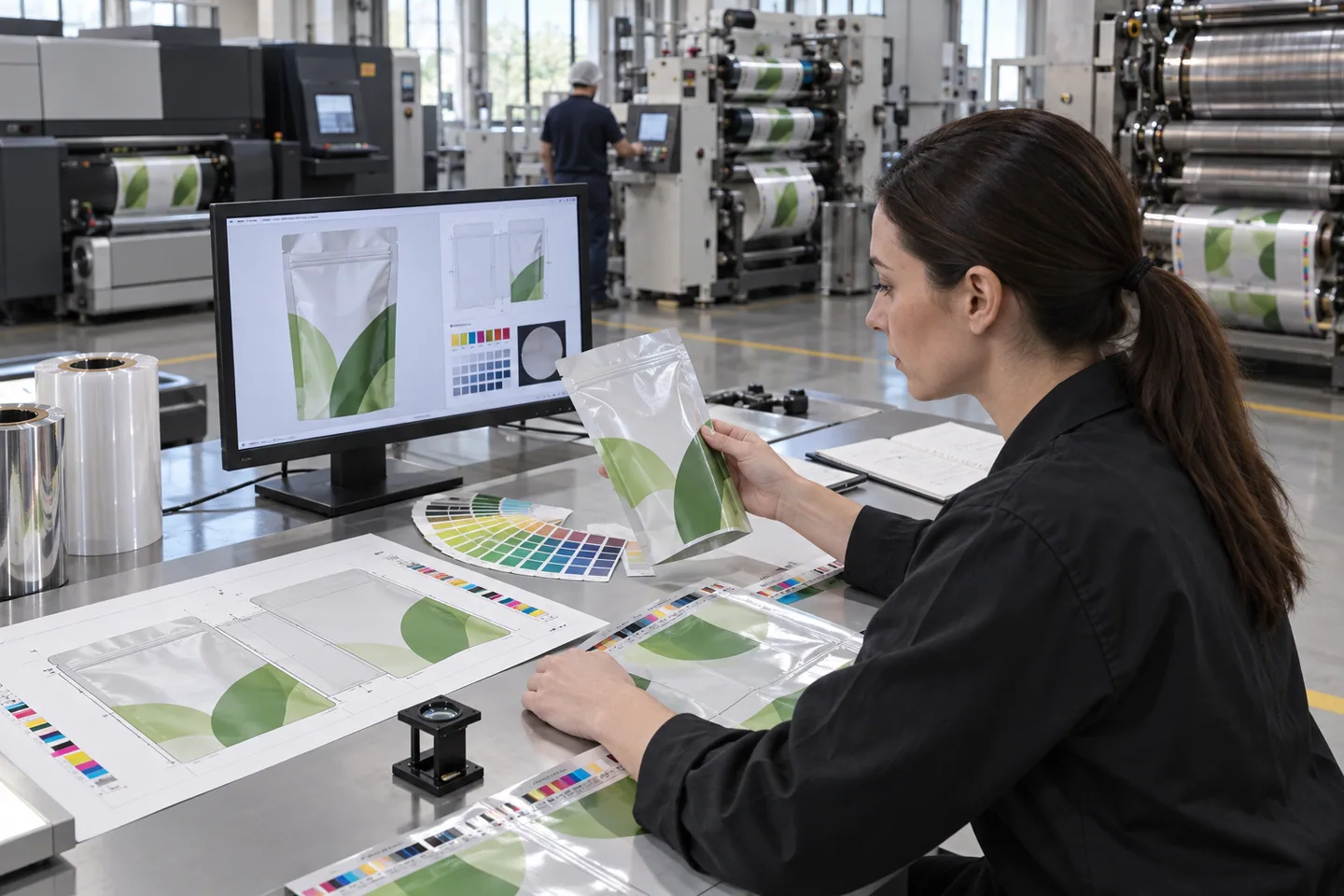
A PDF confirms content, placement and version, not final color. A calibrated contract proof can simulate color within an agreed workflow but may not reproduce the exact film, white ink or finish. A press proof or production-intent sample gives stronger physical evidence but adds setup and material commitment.
Write the purpose on the approval: “layout only,” “color target,” “finish reference” or “production standard.” Do not let one sample silently become evidence for characteristics it was never designed to prove.
Color Control During Factory Production
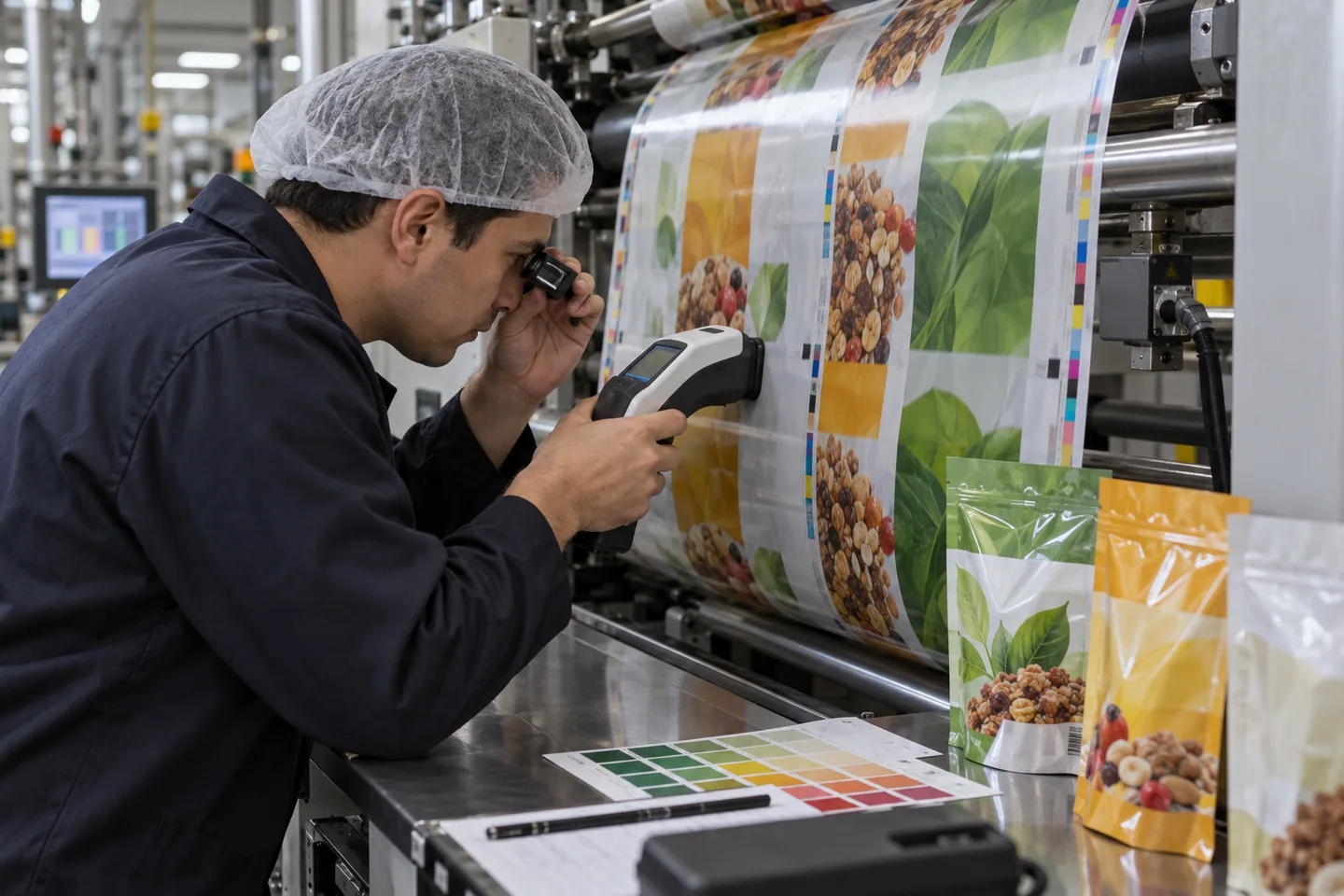
The approved target should be available at the press. Production control may combine instrument readings, visual assessment under agreed lighting and continuous web inspection. The factory should also manage ink viscosity, drying, registration and defects such as streaks, haze, pinholes, blocking or set-off.
After lamination, inspect the final visual result. Adhesive, film and surface finish can change density and gloss. Shipment inspection should sample across the run and across SKUs rather than photograph only one ideal pouch.
Cost and Lead-Time Questions to Ask
- What tooling is included and who owns it?
- Does price apply per SKU, per size or per combined order?
- Which material and finish are included?
- Is white ink or a special coating included?
- What proof is included and what costs extra?
- How long are plates or cylinders stored?
- What happens when artwork changes?
- Which setup steps can be reused for a reorder?
- Are overrun and underrun tolerances stated?
- When does production timing begin: deposit, artwork approval or material confirmation?
Practical Selection Scenarios
New product with four flavors
Digital may deserve early evaluation because design versions and uncertain demand create inventory risk. Confirm that the required laminate, zipper, finish and pouch size are compatible with the proposed digital route.
Established snack brand with stable monthly volume
Flexographic or rotogravure production may provide better long-run economics. Compare tooling, color control, reorder consistency and production scheduling using the actual annual volume.
Premium coffee bag with metallic design
The print method cannot be chosen without the material and white-ink plan. Review the metallic film, matte or gloss finish, valve area and pouch format together. A physical proof is more useful than a screen render.
What to Include in a Printing RFQ
Provide editable artwork, dieline, dimensions, material or performance requirement, finish, number of colors, number of designs, quantity per design, barcode requirements and target delivery. Identify critical colors and whether a prior printed pack is the reference. State if the product will need later date coding or labels so suitable blank areas can be planned.
Link the print decision to printing and finishing options, then confirm the full pouch through the custom packaging process.
Reorders, Tool Ownership and Artwork Version Control
Ask how the printer identifies cylinders, plates and digital files, who owns conventional tooling and how long it is stored. A reorder should reference the approved artwork revision, structure, print process and color target. “Same as last order” is risky when materials, press, ink or finish have changed.
For a brand refresh, define whether old tooling is withdrawn and how obsolete files are prevented from returning to production. When only legal text changes, the affected plate or cylinder may still require replacement; confirm the technical and commercial effect before promising a launch date.
Keep a master SKU table with file name, revision, barcode, size, structure, finish and destination. At shipment inspection, sample every version and compare variable text as well as appearance. A visually excellent pouch with the wrong language or barcode is still nonconforming.
Sustainability and Printing Choices
Ink coverage, dark colors, coatings, metallization and labels can affect a package’s design-for-recycling assessment. Printing method alone does not determine recyclability. If a mono-material PE or PP structure is planned, ask whether inks, primers, lacquers and adhesives are compatible with the selected guideline and whether the final artwork changes the assessment.
Avoid unsupported claims such as “eco-friendly ink.” Request the chemistry category, intended substrate, cure or drying requirements and assessment basis. Color reduction can sometimes support material and process goals, but it should be evaluated against brand recognition and regulatory information.
Print Defects Buyers Should Recognize
- Misregistration: colors or graphics do not align.
- Color drift: appearance changes through the run or between rolls.
- Pinholes or voids: small unprinted areas interrupt solids.
- Streaking or doctor-blade lines: linear defects in ink laydown.
- Dirty print or hickeys: particles create spots or halos.
- Blocking or set-off: printed surfaces transfer or stick.
- Poor adhesion or rub: ink/coating detaches under handling.
- Banding: visible tonal steps, especially in gradients.
Define whether inspection is visual, instrument-based or both, and agree defect limits before shipment. Retain samples from beginning, middle and end of production when repeatability matters.
Frequently Asked Questions
Is digital printing always best for a low MOQ?
Not always. It can reduce conventional tooling, but material, size, finish and converting requirements may limit the route. Compare total delivered cost and usable inventory for the actual project.
Which printing method gives the best color?
All three can produce strong results under proper control. “Best” depends on artwork, substrate, gamut, spot colors, proofing and repeatability requirements.
Can several designs share one MOQ?
Sometimes, but only when size, structure, print route and production planning are compatible. Ask how MOQ is defined per design and whether each version has separate setup or packing costs.
Will the printed pouch match my computer screen?
Not reliably. Screens emit light and vary by calibration. Approve color against an agreed physical or calibrated proof and understand how film and finish affect the result.
Should I keep the same print process for every reorder?
Changing process can change color, screening and appearance. If consistency matters, treat a process change as a new approval and compare production samples.
Conclusion
The right printing method is the one that fits the complete commercial and technical program. Use volume, SKU count, artwork, material, finishing and repeat-order needs to shortlist a route; then control the result through preflight, an appropriate proof and documented production references.
To compare options, send FULL PACKING your artwork, pouch size, material direction, finish, SKU quantities and target timing. The team can identify which information is still needed before a production route is confirmed.