
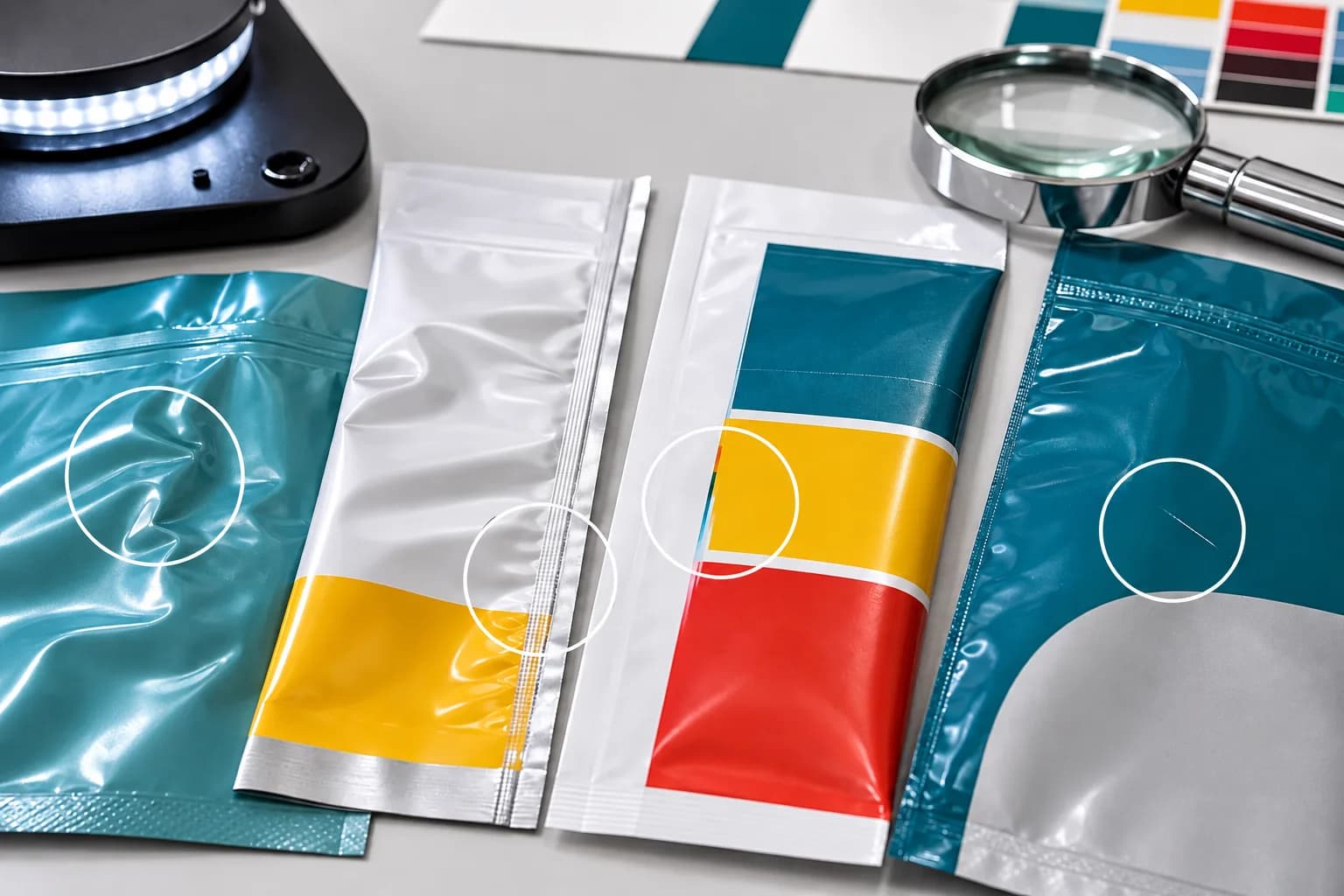

Evaluate a food packaging bag against an agreed specification and a filled sample, not appearance alone. For buyers comparing suppliers, the seven checks below help turn general claims such as high quality into questions that can be verified before a bulk order.
1. Material Structure and Food Contact Suitability
Common film components include PET (polyethylene terephthalate), BOPP (biaxially oriented polypropylene), PE (polyethylene), CPP (cast polypropylene), VMPET (metallized PET) and aluminum foil. These components perform different roles; a material name alone does not establish the finished bag’s performance.
Confirm the complete material structure, individual layer thicknesses where relevant, total thickness and agreed tolerances. Request food-contact documentation appropriate to the destination market and intended food, temperature and contact duration. Inks, adhesives and closures should also be considered where applicable. Avoid treating a generic food-grade description as proof of suitability for every use.
2. Barrier Properties
Water vapor, oxygen, and light can all affect food quality.
For example, coffee and nuts may need strong oxygen protection, while crisp snacks often need a good moisture barrier. Ask for oxygen transmission rate (OTR) and water vapor transmission rate (WVTR) data where relevant, with the test temperature, humidity, units and method stated. Values measured under different conditions should not be compared directly.
Choose barrier requirements around the product and target shelf life. Lower transmission values generally indicate a stronger barrier under comparable test conditions, but there is no single OTR or WVTR target suitable for every food. Test the finished package as well as reviewing film data.
3. Packaging Strength
Packaging bags undergo production, warehousing, handling, and transportation, during which they may be subjected to compression, friction, and drops.
Evaluate the filled package at its intended weight. Ask which puncture, drop, compression or burst checks are appropriate and agree acceptance criteria before production. A thicker film is not automatically a better choice; structure, seals and handling all affect performance.
4. Heat-Sealing Performance
Heat sealing is a critical step in ensuring the package is properly sealed.
An unsuitable combination of sealing temperature, pressure and dwell time can cause weak seals or damage the film. Product dust, oil or liquid in the seal area can also cause leaks.
Check both the supplier’s bag-making seals and the final closure formed after filling. Request a recommended sealing window and verify it on your equipment. A resealable zipper provides convenience after opening; it should not be assumed to provide the same protection as the original sealed package.
5. Print Quality
Food packaging also serves as a vital medium for brand presentation.
Clear text, accurate colors, precise registration, and a clean surface finish all enhance the overall quality of the packaging.
Agree an artwork proof and, when needed, a physical color reference before production. Confirm that product text and barcode readability are acceptable and that inks do not transfer in normal handling. Do not infer food-contact suitability from good print appearance.
6. Bag Style Design
Check bag dimensions, usable capacity, base stability and compatibility with the filling line. Stand-up, three-side seal, flat-bottom and side-gusseted formats serve different display and packing needs. Terminology can vary by supplier, so approve a drawing or sample.
Test zippers, degassing valves, spouts and caps as part of the finished bag. Their attachment, operation and placement should match the intended product and filling process.
7. Production and Quality Control
The final quality of the packaging depends not only on materials and design but also on the production process.
Printing, lamination, curing, bag making and final inspection can all affect performance. Ask how the supplier controls defects, identifies batches and checks outgoing goods against the approved sample and specification.
Before placing a bulk order, agree which checks will be recorded, how nonconforming goods will be handled and how changes to materials or construction will be approved. Quality-control documentation is more useful than an unsupported claim that every bag is guaranteed to perform identically.
Questions to Ask Before Approving a Bulk Order
Can the supplier provide an agreed structure and dimension specification, relevant food-contact documentation, barrier data where needed, filled-sample test results and a final inspection record? Which sealing conditions have been validated on your filling equipment?
Approve performance requirements alongside appearance. Keep the agreed sample, artwork version and specification as references for future orders, and reassess the package if the food, filling process or distribution conditions change.
Share your current bag sample or product requirements with Full Packing to discuss specifications and sample evaluation before requesting a bulk quotation.