
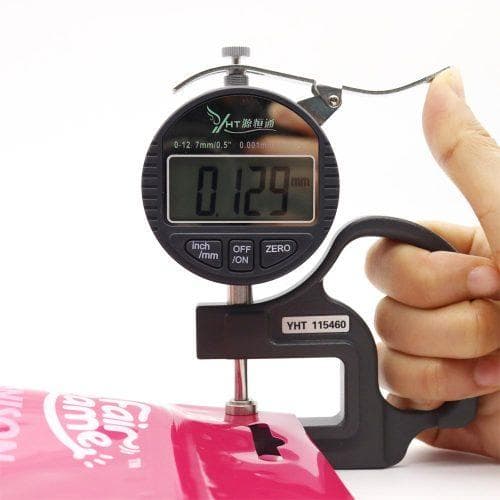
Food packaging materials affect shelf life by controlling exposure to moisture, oxygen and light. Their performance depends on the complete material structure and the integrity of the finished package. The right pouch can help preserve quality, but a material name alone cannot establish how long a food product will last.
For food brands choosing custom packaging, start with the way the product loses quality: does it become soft, develop an off-flavor, lose aroma or change color? This gives the packaging supplier a clearer starting point than simply asking for a thicker bag.
Moisture control helps maintain texture
Chips, crackers and many dry snacks can lose crispness when they absorb moisture. Some powders may cake or clump. Other products need protection against moisture loss. The required barrier therefore depends on the food and the storage environment.
Ask about water vapor transmission rate, or WVTR, for the proposed film structure. Lower WVTR means less water vapor passes through under the specified test conditions. Compare values only when the units, test method, temperature and humidity are consistent.
Oxygen protection matters for oxidation-sensitive foods
Exposure to oxygen can cause quality changes in products containing oxidation-sensitive fats, such as nuts and some snacks. It can also affect aromas and colors. Oxygen barrier requirements should be based on the formulation, packing process and target storage period.
Oxygen transmission rate, or OTR, describes oxygen passing through a material under defined conditions. A low film OTR does not address oxygen already inside the pack or leakage through a poor seal. If nitrogen flushing or vacuum packing is planned, assess it together with the pouch and filling process.
Light protection and visibility involve a trade-off
A transparent pouch or window lets customers see the product, but it also exposes that area to light. For light-sensitive foods, opaque, metallized or aluminum-foil structures may be considered. Some clear films provide substantial oxygen barrier, but transparency does not itself provide light protection.
Metallized film and aluminum foil are different materials. Both can contribute to barrier protection, but the completed laminate, handling and possible damage determine practical performance. Select them against the application rather than assuming every silver-colored pouch has the same barrier.
Each layer contributes a different function
Many food pouches use laminated films. In a PET/VMPET/PE construction, PET commonly supports printing and dimensional stability, VMPET is metallized PET used as a barrier layer, and PE commonly provides the product-contact and heat-sealing layer.
This is an illustrative construction, not a recommendation for every food. Film grades, layer thicknesses, adhesives and converting quality affect the finished package. A material structure suitable for ambient dry snacks should not automatically be used for hot-fill, retort or frozen applications.
Seals and closures are part of the protection system
Strong film cannot compensate for seal channels, pinholes or damaged fitments. Food particles, powder or oil in the sealing area can also affect seal quality. Evaluate the finished bag with the intended filling and sealing equipment.
A zipper offers convenient reclosure, but it should not be assumed to provide the same protection as the original unopened seal. Shelf-life expectations after opening need separate consideration.
What to provide when requesting a material recommendation
Share the product type and form, fill weight, target shelf life, filling method, storage temperature and humidity, and distribution conditions. Explain any known sensitivity to moisture, oxygen or light, and whether a clear window, zipper, valve or spout is needed. Existing samples and current packaging specifications are useful references.
Before approving production, review the proposed structure and relevant performance data, trial filled samples and assess package integrity. Validate the shelf-life target using the actual food and final packaging under representative conditions. Packaging selection supports this process; it does not replace product shelf-life testing.
Frequently Asked Questions
Does high-barrier packaging guarantee a longer shelf life?
No. It can reduce environmental exposure, but the outcome also depends on the food formulation, processing, initial condition, packing method and storage. Confirm the result with filled-product testing.
Is aluminum foil necessary for every food pouch?
No. The appropriate structure depends on the product’s protection requirements, presentation, filling process and cost. Some applications can use other barrier structures.
Can a clear food pouch provide oxygen protection?
Yes. Certain transparent barrier structures can provide oxygen protection. Check the actual performance data and whether the product also needs light protection.
Discuss Your Packaging Requirements
FULL PACKING develops custom flexible packaging around the product and intended use. Share your food type, fill weight, shelf-life target and storage conditions through our contact page to discuss suitable material and sample options.