
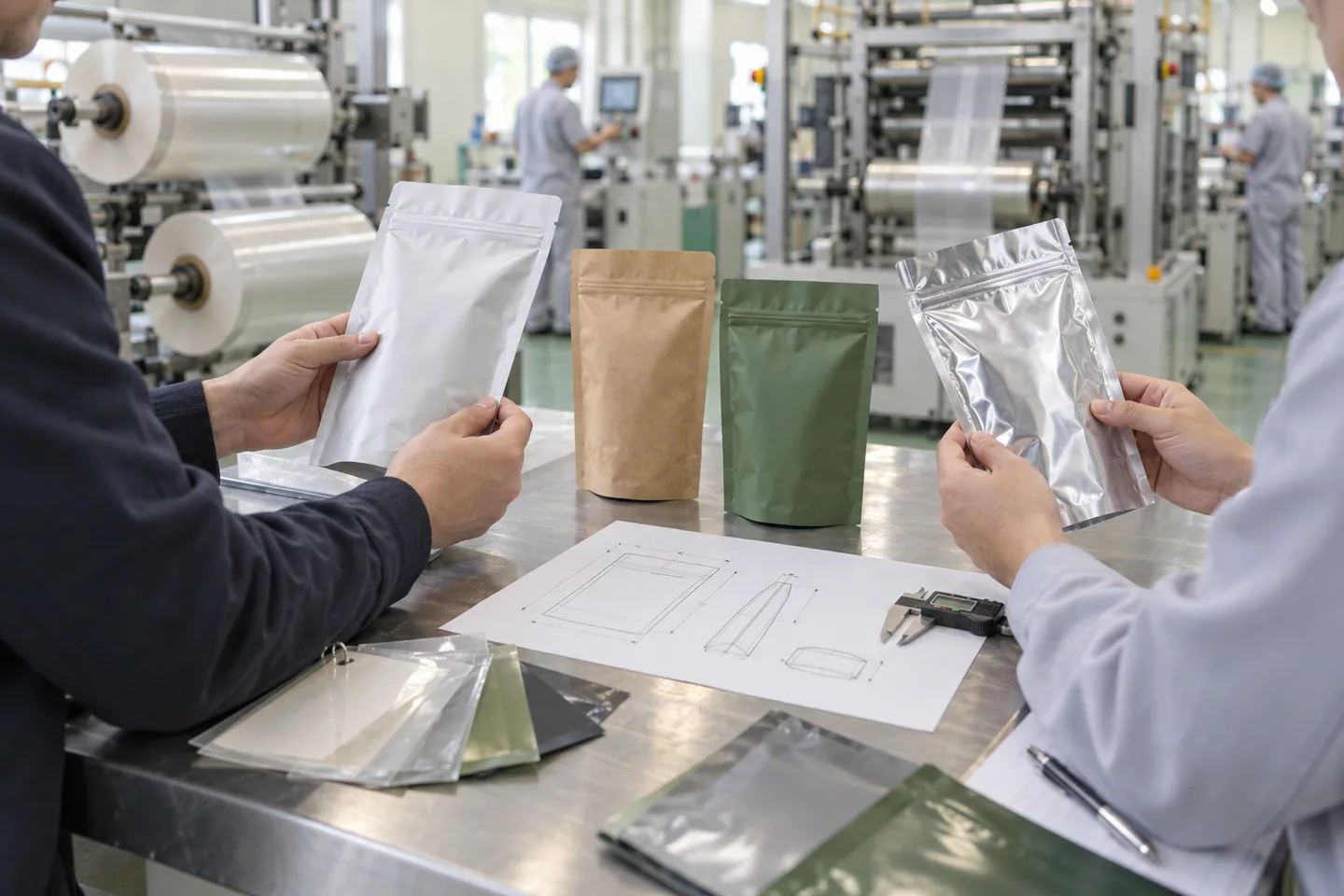
Choosing a flexible packaging manufacturer is not simply a price comparison. A suitable supplier must be able to translate the packed product, filling process, shelf-life objective, artwork and delivery plan into a controlled package specification. The most useful evidence is not a broad promise such as “high quality.” It is a clear trail from requirements to materials, samples, approved artwork, production checks and shipment inspection.
For an overseas buyer, the evaluation should answer three questions. Can the manufacturer understand the application? Can it make the agreed construction consistently? Can the team communicate changes and evidence clearly enough for you to manage risk from another country? This guide provides a practical way to assess those questions before a production order.
Start With Your Project, Not a Generic Supplier Scorecard
The same factory may be a good fit for one project and a poor fit for another. A dry snack pouch, a coffee bag with a valve and a spouted sauce pouch place different demands on materials, converting equipment and testing. Before comparing suppliers, prepare a short project definition:
- Product type and physical form
- Fill weight or volume per package
- Filling temperature and filling method
- Target shelf life and storage conditions
- Destination market and sales channel
- Preferred pouch format and dimensions, if known
- Number of SKUs and estimated quantity per SKU
- Artwork status and finish expectations
- Required zipper, valve, spout, window or opening feature
- Target sample and production dates
This brief prevents a common sourcing error: collecting several prices for packages that are not technically equivalent. If one supplier quotes a simple clear laminate and another quotes a foil-based structure, the unit prices do not answer the same question.
Define what is fixed and what is open to recommendation
Mark each requirement as confirmed, preferred or undecided. A confirmed item might be a filling-machine width limit. A preferred item might be matte appearance. An undecided item might be the exact barrier structure. This tells a prospective manufacturer where it must follow a specification and where it can propose options.
1. Does the Supplier Ask Application-Specific Questions?
A capable first response should do more than ask for size and quantity. The supplier should want to understand what the pouch must do. For food products, relevant questions can include sensitivity to oxygen, moisture, aroma or light; oil or acid content; filling temperature; powder in the seal area; and whether the package will be frozen, heated or exposed to high humidity.
This does not mean a salesperson must solve every technical issue in the first email. It means the supplier recognizes that material structure, sealant, thickness, format and accessories are connected to the application. Be cautious when a single “standard material” is recommended before the product and process are discussed.
What a useful technical reply looks like
A useful reply identifies assumptions. For example: “This preliminary structure is based on a dry product filled at ambient temperature and stored at room temperature. Final suitability should be checked with the actual product and filling process.” Assumptions make a recommendation testable; vague certainty hides risk.
2. Can the Manufacturer Produce the Required Format and Features?
Ask which operations are completed internally and which are subcontracted. Depending on the project, these may include printing, lamination, curing, slitting, pouch converting, zipper insertion, valve application, fitment welding and inspection. Subcontracting is not automatically a problem, but responsibilities and traceability should be clear.
Confirm experience with the actual format: stand-up pouch, flat-bottom bag, side-gusset bag, three-side-seal pouch, shaped pouch or spout pouch. Then ask about the features that affect converting and use:
- Zipper type and position
- One-way coffee valve and placement
- Spout diameter, position, cap and tamper evidence
- Tear notch, laser score or easy-open route
- Hang hole or handle
- Clear window and light-exposure trade-off
- Matte, gloss, metallic or other finish direction
A supplier that can make a feature still needs to show that it fits your complete package. A valve affects artwork space and barrier integrity. A zipper changes filling access and top-seal clearance. A spout creates a fitment-weld area that must be checked for leakage.
3. How Does the Supplier Build and Control Specifications?
The production specification should be more detailed than a product name. “Matte stand-up pouch” is not enough to reproduce an order. A useful specification may include:
- Finished width, height and gusset dimensions with tolerances
- Material layers and nominal total thickness
- Pouch construction and seal geometry
- Print direction, color references and approved artwork revision
- Finish and any unprinted or window areas
- Zipper, valve, spout or other component details
- Packing quantity, carton identification and pallet requirements
- Agreed inspection items and acceptance method
Ask how revisions are approved. Changes to size, material, artwork, zipper position or shipping marks should not depend on an informal message that can be missed. The order, approved drawing and production file should point to the same revision.
Look for controlled approval points
A sound project normally has gates: requirement review, quotation assumptions, dieline or drawing, artwork proof, sample approval where applicable, production authorization and shipment release. The exact workflow may differ, but the decision owner and approved reference should be visible at each stage.
4. What Samples Will You Receive—and What Will They Prove?
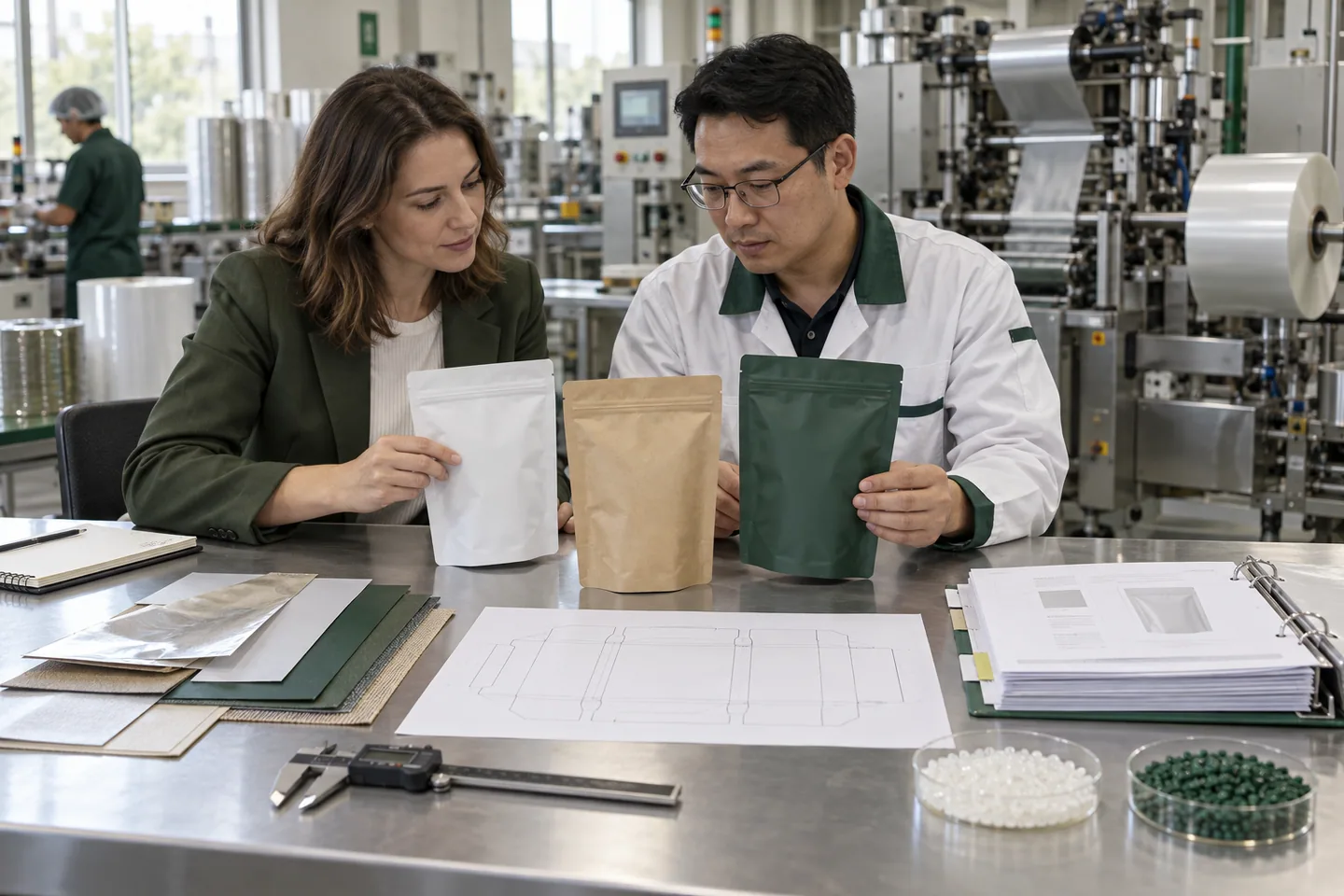
“Sample” can mean several different things. Ask what question each sample answers.
An existing factory sample can demonstrate general print, film, zipper or format capability, but it does not validate your product. An unprinted prototype can help check dimensions, capacity, filling access and feature position. A digitally printed mock-up can help with layout and appearance but may not represent final production color or material behavior. A production-intent sample provides more evidence but may require tooling, material and setup commitments.
Use the actual product for fill trials when safe and practical. Record product density, target net weight, headspace, sealing method and handling conditions. A pouch that looks correct when empty may bulge, tip, wrinkle or leave insufficient top-seal clearance after filling.
Ask how samples are identified
Samples should be linked to dimensions, structure and revision. If a team approves a loose pouch with no reference, it may be difficult to know what mass production is expected to match. Keep one approved reference under suitable storage conditions and document any characteristics that cannot be judged visually.
5. Which Quality Checks Match the Real Risks?
Quality control should begin with the application and approved specification. Buyers should ask which incoming, in-process and final checks are used and what records can be supplied for the order.
Relevant checks may include:
- Material identity and thickness review
- Finished pouch dimensions
- Print appearance and registration
- Lamination appearance and curing status
- Seal width, continuity and strength
- Leak or integrity checks appropriate to the format
- Zipper opening and reclosure
- Valve position and function
- Spout weld, cap fit and torque-related checks where relevant
- Odor and visible contamination review
- Quantity, carton labels and shipping marks
The method and conditions matter. A result without sample orientation, conditioning, test speed, temperature or acceptance basis may be difficult to compare. Do not assume one laboratory number guarantees shelf life or distribution performance.
Connect factory testing to customer use
Factory checks confirm agreed manufacturing characteristics; they do not replace product-package validation. The buyer may still need filled-package trials, distribution testing, storage studies, compatibility review or destination-market compliance work. A trustworthy supplier should state this boundary clearly.
6. Can the Supplier Explain Food-Contact Evidence Responsibly?
For a food package, ask what compliance evidence is available for the proposed components and intended conditions of use. The answer should relate to the destination market, food type, contact condition and temperature—not merely say “food grade.”
Depending on the project and jurisdiction, the document set may include supplier declarations, component compliance statements, migration or other test reports, specifications and traceability information. Confirm whether reports cover the same material family, thickness, color, adhesive, ink system and use conditions as your order.
The packaging manufacturer should not invent regulatory conclusions for the brand owner. Labels, claims, filled-food compliance and market-specific obligations require review by the responsible business and, where needed, qualified regulatory advisers.
7. How Are Printing and Color Expectations Managed?
Artwork approval is a major source of delay and dispute. Ask which print process is proposed, why it fits the order and how colors are approved. Digital, flexographic and rotogravure printing have different setup, repeatability and economic characteristics.
Clarify:
- Required file format and dieline
- CMYK and spot-color treatment
- Brand-critical color references
- Minimum text, line and reverse-print limitations
- Barcode and variable-code areas
- How matte, gloss, metallic layers and transparent windows affect appearance
- Whether the approval is a screen PDF, contract proof, drawdown, printed sample or signed production reference
Monitor color under agreed lighting and on the intended substrate or a clearly defined simulation. A monitor image is not a physical color standard.
8. Does the Factory Communicate Production and Delivery Status Clearly?
Overseas projects need a simple communication rhythm. Identify one commercial contact and, when appropriate, a technical or quality contact. Ask which milestones will be reported: material preparation, printing, lamination, curing, pouch conversion, inspection, packing and dispatch.
A responsible lead-time discussion separates artwork approval, material preparation, production, quality release and transport. It also states dependencies. A date provided before artwork, material and quantity are confirmed is only an estimate.
For shipment preparation, confirm carton strength, inner protection, unit count, labels, palletization if used, shipping marks and moisture protection appropriate to the route. Shipment inspection should compare the goods with the approved specification, not rely on a few attractive photographs.
9. Are Quotations Complete and Comparable?
Build a comparison sheet rather than reading unit price alone. Record:
| Item | What to compare |
|---|---|
| Package | Format, dimensions, material, thickness and features |
| Printing | Process, color count, finish and number of designs |
| Quantity | Per size, per SKU and total order assumptions |
| One-time costs | Cylinders, plates, dies, samples or testing |
| Quality | Included checks, reports and third-party work |
| Packing | Pieces per bundle/carton and pallet requirements |
| Commercial term | Currency, validity, payment and Incoterm |
| Timing | Approval, production and shipment assumptions |
If two quotations use different specifications, normalize them before deciding. A lower unit price may exclude a feature, use a different material, assume a higher quantity or stop at a different delivery point.
10. What Can You Verify About the Business?
Review the legal company name used for contracts and payment, office and factory information, published contact channels and the relationship between the brand and legal entity. Ask for a live factory call, relevant production evidence or an audit when the project risk justifies it.
Photographs are useful only when they support a coherent process. Look for material identification, printing or lamination stages, converting equipment, inspection activity, packed goods and traceable documents. Avoid treating a single machine image as proof of every capability.
For FULL PACKING, the website identifies the international brand and the legal company as Huizhou Fuxinda Technology Co., Ltd. Buyers can review the company introduction, factory process, quality approach and published contact information before discussing project-specific evidence.

A 15-Question Shortlist for Supplier Calls
- What information do you need before recommending a structure?
- Which parts of this pouch are produced internally?
- Have you made this format and feature combination before?
- What assumptions are included in the quotation?
- How are dimensions, materials and tolerances documented?
- Which sample type should we approve and what will it validate?
- How do you control artwork revisions and brand colors?
- Which tests address our product and distribution risks?
- What food-contact evidence is relevant to our destination and use?
- How are zippers, valves or spouts checked?
- What are the main causes of variation for this construction?
- Which production milestones will you report?
- What is included in shipment inspection?
- How are complaints, retained samples and corrective actions handled?
- Which details could change MOQ, price or timing after approval?
What to Send Before Requesting a Final Quote
Send a structured brief, artwork or draft design, target quantities by SKU, destination, timeline and any existing package sample. If the bag size is not confirmed, provide the actual product, fill weight, density and preferred shelf profile. If the material is undecided, state the required performance rather than copying a competitor’s layer structure.
At this stage, ask the supplier to return a quotation with explicit assumptions and open questions. That response is itself part of the evaluation: it shows whether the team can turn incomplete commercial input into a controlled technical conversation.
Frequently Asked Questions
Should I always choose the flexible packaging manufacturer with the lowest MOQ?
No. A low MOQ may help a launch, but compare the actual material, print method, unit cost, setup charges, sample route, repeat-order consistency and delivered cost. The best option is the one that fits the project’s risk and volume, not the smallest number in isolation.
Does a factory certificate prove that my pouch is compliant?
Not by itself. A management-system or facility certificate has a different purpose from material compliance evidence or a finished-package test. Check the certificate scope, validity and issuing body, then review product-specific documentation for the intended market and use.
Is a video factory tour enough?
It can support an initial review but does not replace a specification, audit or project evidence. Use it to verify workflow and equipment, then request the records and samples relevant to your order.
How many manufacturers should I compare?
There is no fixed number. A focused shortlist of suppliers that can address the application is usually more useful than collecting many non-equivalent quotes. Normalize specifications and commercial terms before scoring them.
When should I arrange a third-party inspection?
Consider project value, first-order risk, complexity, destination requirements and your internal controls. If used, define the inspection scope and acceptance criteria before production, not after the goods are packed.
Conclusion
The strongest supplier evaluation follows the same path as a controlled packaging project: define requirements, document assumptions, review samples, approve a specification, verify production and inspect shipment against an agreed reference. Price matters, but it becomes meaningful only after the packages being compared are technically and commercially equivalent.
FULL PACKING supports custom flexible-packaging discussions around product, format, material, printing, functional features and production details. Send your requirements with the product, fill quantity, preferred format, number of SKUs and target order volume so the next technical questions can be identified.