
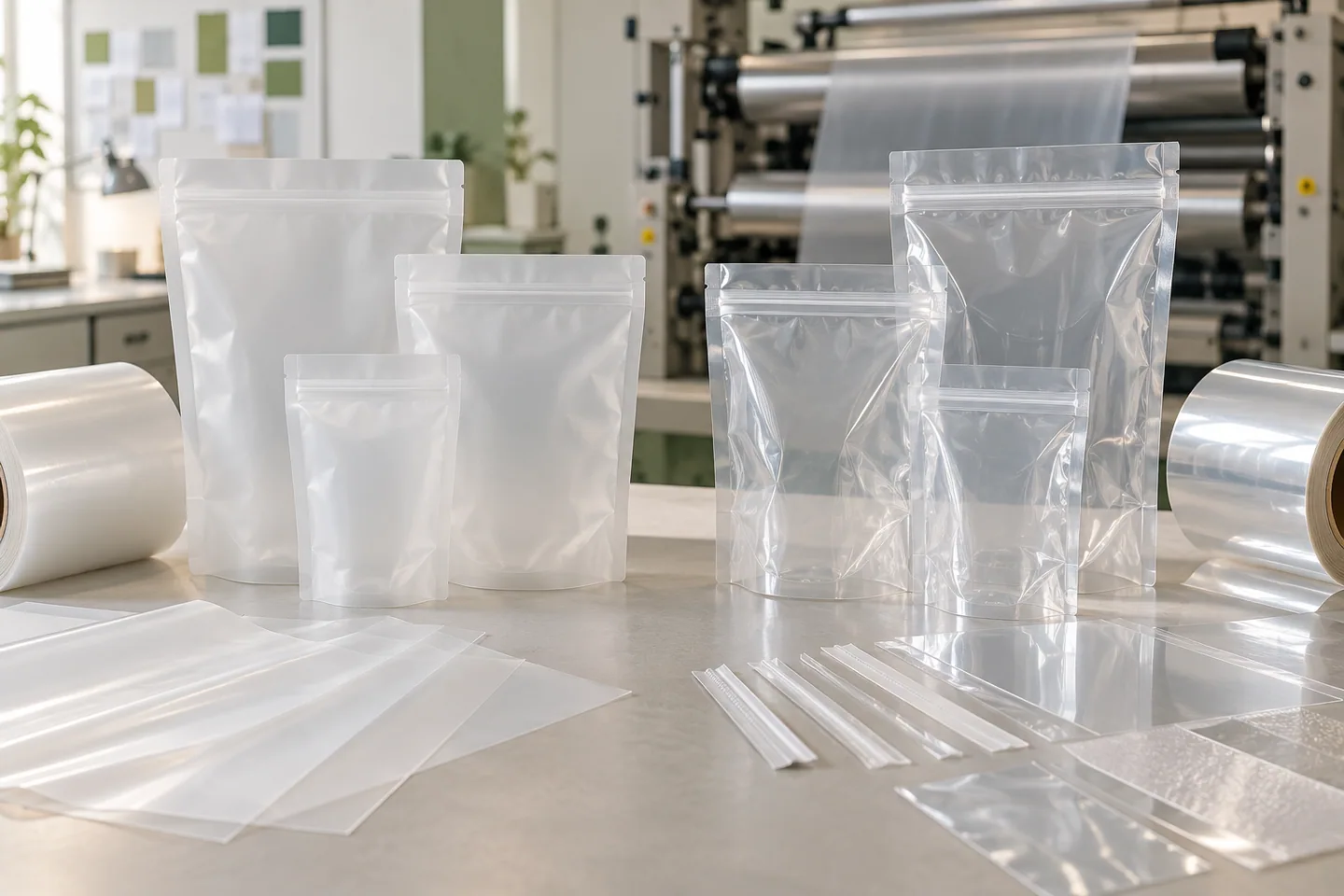
Mono-material flexible packaging is designed so the dominant structure belongs to one compatible polymer family, commonly polyethylene (PE) or polypropylene (PP). This can improve compatibility with designated collection, sorting and mechanical-recycling streams, but “mono-material” does not automatically mean recyclable everywhere. The complete package—films, barrier layers, coatings, adhesives, inks, zipper, valve, spout and labels—must be assessed against current guidance and local infrastructure.
The engineering challenge is to preserve product protection, seal integrity, machinability and consumer use while simplifying the material system. A successful transition starts with requirements and testing, not with replacing every layer on a one-for-one basis.
What Mono-Material Means in Practice
A pouch described as mono-PE may use several PE-based films with different densities, orientation or functions. A mono-PP pouch may combine PP films designed for print, stiffness, barrier and sealing. Small amounts of adhesives, inks or functional layers may still be present, subject to the criteria of the relevant design-for-recycling scheme.
Because thresholds and test methods evolve, ask which guideline, version, market and assessment method support any recyclability claim. CEFLEX D4ACE and RecyClass publish detailed guidance for flexible packaging, but local collection and sorting remain decisive.
Why Brands Consider Mono-PE or Mono-PP
- Alignment with packaging-reduction or recyclability goals
- Customer or retailer design requirements
- Preparation for changing policy and EPR criteria
- Simplification of multi-material laminates
- Potential access to established polyolefin recycling streams
These goals do not remove the package’s first job: protecting the product. A structure that causes leakage or food waste is not a responsible improvement.
Mono-PE Pouch Characteristics
PE offers strong heat-sealing behavior and toughness, which can suit many pouch and rollstock applications. Oriented PE films can add stiffness and printability, while sealant PE layers support closure formation. The practical structure depends on equipment and supplier technology.
Potential challenges include achieving the desired stiffness, heat resistance, optical appearance and barrier without adding incompatible components. The sealing window and web handling can differ from a conventional PET/PE laminate. Test print, lamination, pouch conversion and filling as a connected process.
Mono-PP Pouch Characteristics
PP-based structures can offer clarity, stiffness and heat resistance with compatible sealant layers. They may be considered for applications that benefit from a crisp package feel or particular processing window.
Challenges can include toughness at low temperature, sealing range, flex performance and compatibility with the intended recycling stream. Do not assume a mono-PP pouch will run like an existing BOPP/PE or PET/PE structure.

Barrier Is More Than One Number
Product protection can require control of oxygen, moisture, light, aroma or grease. A conventional laminate may use foil, metallized PET or other distinct barrier layers. Mono-material development can use coatings, metallization, EVOH or other technologies, but compatibility depends on type, amount, construction and the selected guideline.
Specify target OTR and WVTR only with test conditions, units and package context. Film data does not automatically predict finished-pouch performance because folds, seals, flexing, valves and processing can affect barrier. Validate the complete package with the actual product and shelf-life plan.
Inks, Adhesives and Coatings
These components may be a small percentage by weight but can affect recycling quality, odor, color and process yield. Design-for-recycling guidance may set compatibility categories or thresholds. Review:
- Ink coverage and color, especially dark or carbon-black systems
- Adhesive chemistry and total amount
- Lacquers and matte or tactile coatings
- Barrier coatings and primers
- Metallization level
- Print orientation and de-inking behavior where relevant
Do not ask only whether the base film is PE or PP. Request a complete-package assessment.
Zippers, Valves, Spouts and Labels
A zipper of a compatible polymer family may support the design direction, but geometry and amount still matter. Coffee valves, spouts, caps, labels and sleeves can change sortability or recyclate quality. Components should be designed for compatibility or separation according to the relevant guidance.
For a spout pouch, the fitment must also weld reliably to the film. Product performance and recyclability objectives must be solved together.
Printing and Shelf Appearance
Changing substrate can alter color, gloss, transparency, stiffness and tactile feel. Brand teams should review physical proofs on the intended structure. Metallic effects or opaque white layers can affect sortability and appearance. Avoid approving sustainability claims before the visual and technical construction is final.
Converting and Filling-Line Validation
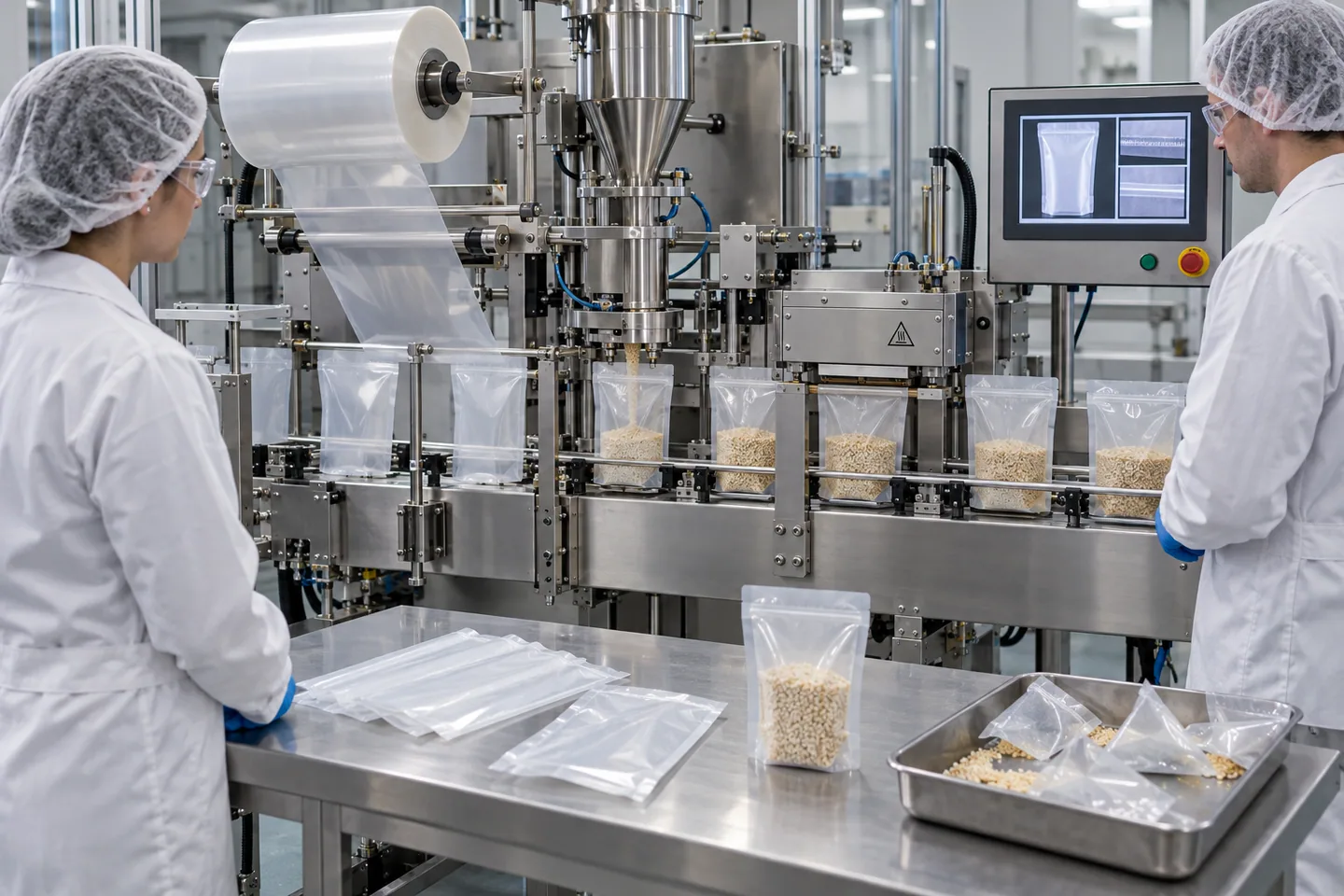
Mono-material structures may have different friction, curl, stiffness, heat response and sealing window. During pouch conversion, check tracking, lamination bond, zipper insertion, gusset formation and seal appearance. During filling, check feeding, opening, product drop, contamination, final sealing and code adhesion.
Use a staged trial:
- Laboratory film and seal review
- Short converting trial
- Unfilled dimensional and functional inspection
- Filling-line trial with representative product
- Filled-package integrity and distribution test
- Shelf-life or product compatibility validation
- Recyclability assessment under the target scheme
How to Make a Defensible Recyclability Claim
First identify the market and current consumer collection route. Then identify the applicable protocol or guidance and assess the complete package. Keep technical evidence and wording aligned. “Designed for recycling,” “recyclable where facilities exist” and a certified recyclability rating are not interchangeable.
Claims may be regulated and can change as infrastructure or law evolves. Obtain legal and technical review for the destination. Provide clear disposal instructions only when supported.
Comparison: Conventional Laminate vs Mono-Material Direction
| Question | Conventional multi-material laminate | Mono-material PE/PP direction |
|---|---|---|
| Barrier design | Broad established combinations | May require optimized coatings or compatible barriers |
| Sealing | Often uses dedicated PE or CPP layer | Designed within PE or PP family |
| Stiffness/appearance | Tuned with dissimilar layers | Tuned through orientation and same-family films |
| Recycling | Material separation can be difficult | Better alignment with selected polyolefin streams when designed correctly |
| Conversion | Familiar on established lines | May require revised tension, temperature and handling |
| Claim basis | Often no recyclability claim | Still requires complete-package and local-system assessment |
Questions to Ask a Supplier
- Is the proposal mono-PE, mono-PP or mixed polyolefin?
- Which design-for-recycling guideline and version were used?
- What percentage and type of non-PE or non-PP components remain?
- How are barrier, adhesive, ink and coating compatibility assessed?
- Are zipper, valve, spout and labels included in the claim?
- What OTR/WVTR conditions and finished-package data are available?
- Which filling-line changes might be required?
- What samples and trials precede production?
- Which markets have compatible collection and sorting?
- Who approves consumer-facing claims?
When a Mono-Material Pouch May Not Yet Be the Right Route
If the product requires a demanding barrier, high-temperature treatment, aggressive chemical resistance or unusual mechanical performance, an available mono-material option may not meet all requirements. The responsible outcome may be further development, another package format or a conventional structure while technology and recycling routes mature.
Avoid sacrificing seal integrity or shelf life to reach a headline claim. Document the trade-off and retest when materials change.
Explore materials and barrier options and send the application requirements before choosing a structure.
Translate a Sustainability Brief Into Measurable Requirements
“Make it recyclable” is not a complete brief. Define the target country, retailer or design guideline; required barrier; shelf life; fill and storage temperature; pack format; zipper or fitment; print coverage; and consumer-disposal message. Rank requirements as mandatory, preferred or exploratory.
Ask what is changing from the current structure and why. If the existing laminate uses PET for stiffness and PE for sealing, a mono-PE development must recreate enough stiffness through PE-family film design rather than simply removing PET. If foil provides light and oxygen protection, a replacement needs a measured performance target and product validation.
Performance Specifications for a Trial
A trial plan can include:
- OTR and WVTR with temperature, humidity, units and method
- Seal-initiation range, seal strength and hot tack
- Puncture, drop or flex resistance relevant to distribution
- Coefficient of friction and web/pouch feeding
- Dimensional stability and curl
- Zipper or fitment compatibility
- Print adhesion, rub and finish appearance
- Filled-package leakage and shelf-life checkpoints
- Design-for-recycling assessment for the complete pack
Set acceptance from product risk and equipment, not from a generic material datasheet. Film values, converted-pouch values and filled-pack performance should be distinguished.
A Low-Risk Conversion Path
Start with one representative SKU rather than changing the entire portfolio. Select a product with known shelf-life data and manageable barrier needs. Produce laboratory structures, then run a converting trial and a filling-line trial. Keep the current package as a control through storage and distribution studies.
Review consumer appearance and use as well as technical results. A stiffer or softer pack can change perceived fill, opening and shelf stability. If the new design succeeds, define change control before scaling to other sizes or products.
Commercial and Supply Questions
New films, coatings or compatible accessories may have different minimums, production windows and supplier availability. Ask whether the structure is commercial, pilot-scale or development-stage. Identify alternate sources and determine whether a substitution would require renewed testing.
Compare total cost across material, converting yield, line speed, waste, shelf life, claim review and inventory—not resin or pouch price alone. A structure that requires frequent line stops or increases product loss may not deliver the intended environmental or commercial result.
Evidence Package for Internal Approval
Prepare a short decision file containing the old and new specifications, functional targets, trial reports, filling-line results, shelf-life status, recyclability-assessment scope, artwork and claim approval, plus open risks. This helps procurement, quality, marketing and sustainability teams approve the same package rather than parallel interpretations.
Frequently Asked Questions
Is a mono-PE pouch 100% polyethylene?
Not necessarily. It may contain inks, adhesives, coatings and components within limits defined by a particular assessment. Ask for the complete construction and claim basis.
Is mono-material packaging recyclable in every country?
No. Collection, sorting, recycling technology and acceptance differ by market. Confirm the local route and wording.
Can a mono-material pouch provide high barrier?
Some structures use compatible barrier technologies, but performance and recyclability must be demonstrated for the actual construction. Define product needs and test the finished pack.
Is mono-PE better than mono-PP?
Neither is universally better. Compare sealing, stiffness, temperature, toughness, optics, filling equipment and the target recycling stream.
Do I need to rerun shelf-life tests?
Yes when the structure changes in a way that can affect product protection. Prior results from a conventional laminate should not automatically be transferred.
Conclusion
Mono-material pouch development is a performance-and-circularity project, not a simple material swap. Define the market and product requirements, assess every component, validate converting and filling, and use careful claim language supported by current guidance.
Send FULL PACKING the product, shelf-life target, current structure, destination and recyclability objective to discuss feasible development steps.