
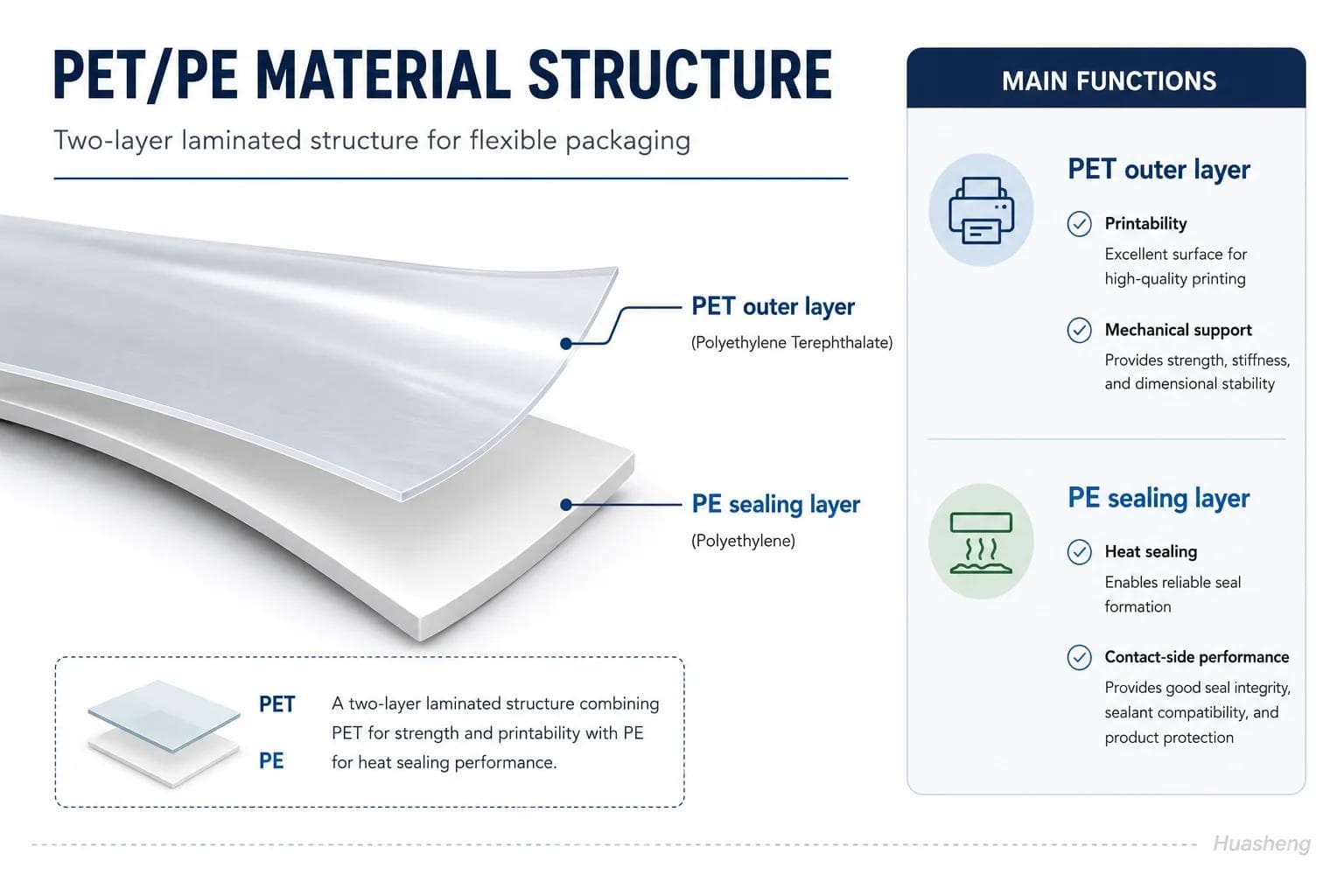
PET and PE are different polymers that often perform complementary roles in flexible food packaging. PET film commonly provides a stable print surface and stiffness, while PE film commonly provides flexibility and heat sealing. A PET/PE pouch combines these functions in one laminate.
This comparison concerns flexible packaging films. It does not cover every PET bottle, PE container or specialty film grade, and it should not be treated as a universal rule for all packaging applications.
What is PET film?
PET stands for polyethylene terephthalate. In many laminated food pouches, the outer film is biaxially oriented PET, also called BOPET. It is commonly selected for its mechanical properties, dimensional stability and suitability for printing and lamination.
Standard PET print films commonly rely on another layer for heat sealing. However, heat-sealable PET grades also exist. PET should therefore not be described as a material that can never be heat sealed or used in food-contact applications.
What is PE film?
PE stands for polyethylene. PE-based films are widely used as sealant layers in food pouches because suitable grades provide flexibility, toughness and heat-sealing performance. Their properties vary with resin grade, blends and film construction.
PE can also be printed after suitable surface treatment and used in constructions where it forms more than the inner layer. Its role is not limited to a hidden lining.
PET and PE: a practical comparison
| Property | PET film: common role | PE film: common role |
|---|---|---|
| Position in a conventional laminate | Outer print/support layer | Inner sealant layer |
| Mechanical contribution | Stiffness and dimensional stability | Flexibility and toughness, depending on grade |
| Printing | Common print substrate | Can be printed with suitable treatment |
| Heat sealing | Standard print grades usually need a sealant layer; sealable grades exist | Suitable grades commonly provide the seal |
| Barrier performance | Depends on grade, coatings and construction | Moisture resistance can be useful; basic PE is not a high oxygen barrier |
Why are PET and PE laminated together?
In a conventional PET/PE laminate, PET commonly forms the outer layer and PE the inner sealing layer. Printing may be placed on the inside surface of the outer film so the laminate protects it. Adhesives join the films and form part of the construction.
This combination can balance presentation, handling and sealing requirements. However, the words “PET/PE” alone do not specify the film grades, total thickness, barrier level or suitability for a particular food. Buyers need the complete construction and intended conditions of use.
When are additional barrier layers needed?
Some products need oxygen, moisture or light protection that a basic PET/PE construction may not provide. Depending on the application, options may include metallized PET, aluminum foil, coated films or other barrier layers.
VMPET means vacuum-metallized PET. In an illustrative PET/VMPET/PE laminate, the middle film contributes barrier protection. It is not the same as a separate aluminum-foil layer. Actual performance depends on the grade and completed laminate, including its condition after converting and handling.
Nuts and oil-containing snacks may require particular attention to oxidation. Dry powders may be sensitive to moisture. A clear window changes light exposure and may also change barrier performance, depending on how it is constructed. Material selection should follow the product requirement rather than a standard list of films.
How to choose a structure for your food product
Explain the product composition, fill weight, target shelf life, filling method and storage conditions. Identify whether the pouch needs a zipper, valve, spout or transparent window. Ask how the proposed layers support these requirements.
Evaluate sealing and handling with representative filled samples. Hot-fill, retort and frozen applications require suitable structures and grades; a general PET/PE description does not establish suitability for these processes.
Frequently Asked Questions
Is PET better than PE for food pouches?
Neither is universally better. In many laminates, PET supports printing and stiffness while PE provides the sealing layer. The appropriate combination depends on the finished pouch requirements.
Is PET/PE the same as a recyclable PE pouch?
No. PET/PE combines different polymer families. Recyclability depends on the full construction and the collection and recycling systems in the destination market; it should not be inferred from the presence of PE alone.
Does every PET/PE bag provide high oxygen barrier?
No. The structure name does not define its oxygen transmission rate. Request data for the specific film construction under stated test conditions.
Discuss Your Material Structure
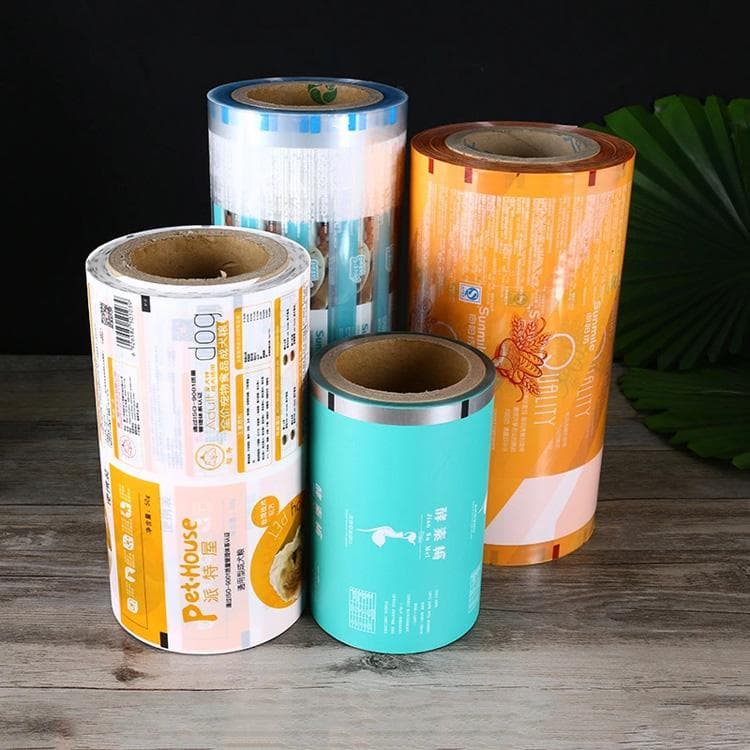
FULL PACKING can review your product and packaging brief to discuss custom pouch options. Send your intended use, pack size, filling process and protection requirements through our contact page.