
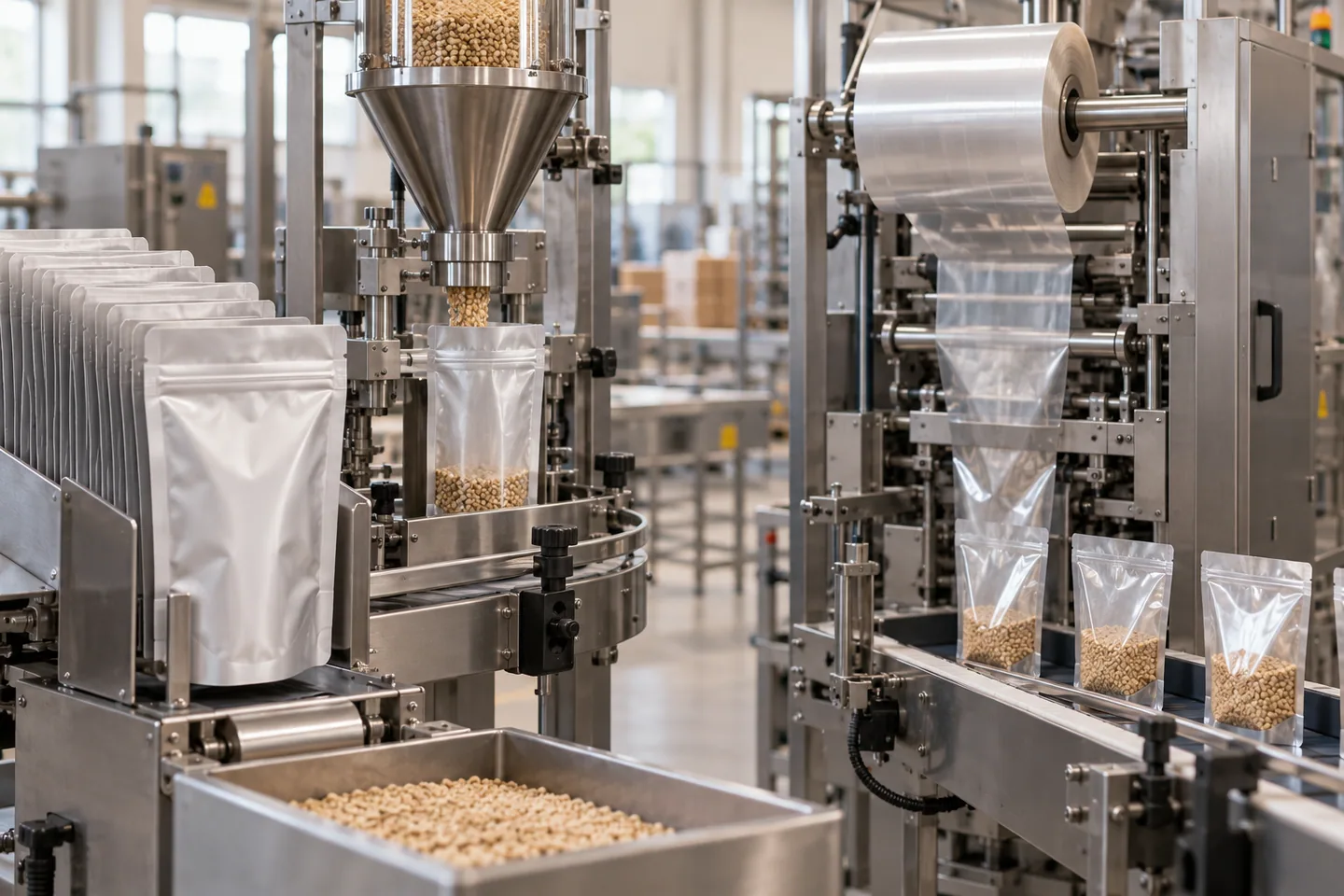
Premade pouches arrive at the packing site already converted into bags and are opened, filled and finally sealed. Rollstock arrives as printed or unprinted film and is formed into packages on form-fill-seal equipment. Neither format is universally more efficient. The right choice depends on product, desired pouch shape, line speed, changeover, labor, capital equipment, seal control, artwork repeats, waste and launch volume.
Buyers should evaluate package supply and filling equipment together. A low pouch price cannot compensate for an incompatible machine, and a fast form-fill-seal line is not economical if SKU changeovers or production volume leave it underused.
How Premade Pouch Filling Works
Premade pouches are manufactured by a converter through printing, lamination, curing, slitting and pouch making. At the packer, the machine or operator picks a pouch, opens it, fills the product and makes the final top seal or applies the required closure.
This route can support stand-up, flat-bottom, side-gusset, three-side-seal, shaped and spout formats depending on equipment. Zippers, valves and some fitments can be installed by the pouch manufacturer before delivery.
How Rollstock Packaging Works
Rollstock is fed through form-fill-seal machinery. The equipment forms film around or into a package, creates longitudinal and transverse seals, fills the product and cuts the pack. Vertical form-fill-seal is common for many dry products; horizontal systems serve other formats and applications.
The buyer must specify web width, repeat length, unwind direction, core, roll diameter, splice rules, registration marks, coefficient of friction, sealant orientation and other machine-related details. Rollstock quality is inseparable from machine setup and forming performance.
Format Flexibility
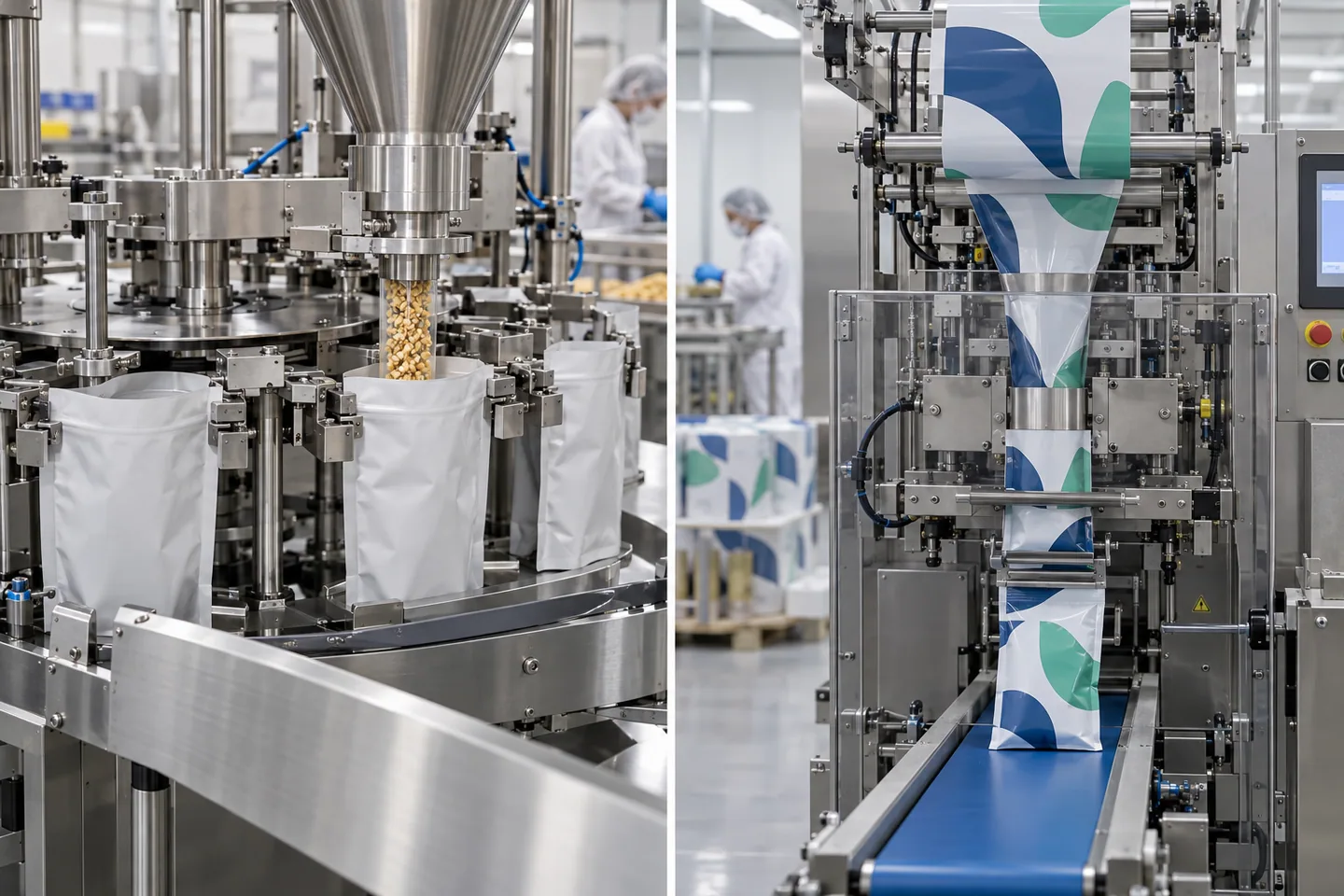
Premade pouches can provide complex shelf shapes and features without requiring the filler to form the complete pouch. This can be attractive for flat-bottom bags, shaped pouches, valve coffee bags or spout pouches.
Rollstock is efficient for formats the machine is designed to form. It may offer fewer structural choices on a given line but strong repeat throughput. Changing from a pillow bag to a stand-up format can require different equipment or tooling, not merely a new film roll.
Capital Equipment and Launch Readiness
A startup with manual or semi-automatic filling may choose premade pouches to avoid immediate investment in a form-fill-seal line. An established packer with suitable equipment may prefer rollstock for throughput and integrated package formation.
Compare:
- Equipment purchase or co-packing cost
- Installation preparation and utilities
- Operator training
- Change parts and tooling
- Factory acceptance and site acceptance tests
- Maintenance and spare parts
- Cleaning and allergen-changeover requirements
- Expected utilization, not theoretical maximum speed
A co-packer can change the decision. Confirm what materials, web dimensions and premade pouch features its equipment accepts before approving packaging.
Line Speed and Overall Efficiency
Rollstock equipment can achieve high speed for compatible stable programs. Premade pouch lines can also be automated, but pouch pickup, opening and feature variation influence output. Quoted machine speed is not the same as sustained good-pack output.
Measure overall performance using saleable packs, changeover time, rejects, downtime, labor and cleaning. A slower nominal line with reliable feeding can outperform a faster line that frequently stops on curled or inconsistent material.
SKU Changeovers
Premade pouches arrive separated by SKU, which simplifies some changes but requires inventory of finished bags. Rollstock changes may involve roll replacement, threading, registration, coding and recipe settings. Multiple film widths or repeat lengths can require tooling changes.
For many low-volume flavors, digital-printed premade pouches can reduce conventional tooling and finished-goods risk. For stable high-volume products, rollstock may provide strong economics. Use actual annual demand, campaign length and obsolete-artwork risk.
Material and Seal Considerations
Premade pouches include factory-made side, bottom and feature seals; the filler is responsible for the final closure. Rollstock lines create most package seals at the filling site. The quality plan should assign responsibility accordingly.
For premade pouches, validate opening, grip, zipper clearance, final-seal lane and feeding consistency. For rollstock, validate web tracking, forming, registration, coefficient of friction, static, seal windows and cut position. Both require product-contamination control in the seal area.
Printing and Artwork Layout
Premade pouch artwork uses a converter dieline showing panels, gussets, seals, zipper and features. Rollstock artwork uses repeat dimensions and must account for machine direction, eye marks, lap or fin seal and cut position.
An artwork file that looks correct as a flat rectangle may place text across a back seal or cut. Ask for a formed-package mock-up and confirm unwind direction with the actual machine diagram. Barcode and code areas must remain readable after formation.
Inventory and Cash Flow
Premade pouches tie inventory to a finished size and design. They are ready to fill but cannot easily be repurposed after an artwork or regulation change. Rollstock is also design-specific, though production and storage economics differ.
Calculate inventory in weeks of demand by SKU, not total pieces. Include minimum production, overrun/underrun, safety stock, shipping time and seasonal risk. A lower unit price can create a higher write-off if demand shifts.
Waste and Sustainability
Compare total system waste: print and converting setup, pouch rejects, roll change, machine startup, product giveaway, leaking packs and obsolete inventory. Flexible packaging material use is only one part of the environmental picture.
The same recyclable-design questions apply to premade pouches and rollstock. Assess the complete structure and local infrastructure; do not assume roll form or pouch form determines recyclability.
Quality Checks for Premade Pouches
- Dimensions and feature position
- Pouch opening and feeding consistency
- Factory seals and gusset formation
- Zipper, valve or spout function
- Print registration and finish
- Bundle orientation and count
- Final seal after filling
- Filled-package integrity and distribution
Quality Checks for Rollstock
- Web width, repeat and thickness
- Roll diameter, core and winding
- Unwind direction and splice identification
- Registration mark and print position
- Tension, curl and coefficient of friction
- Sealant orientation and seal window
- Forming and cut-off position
- Finished-pack seals, coding and integrity
Installation Preparation for a New Line
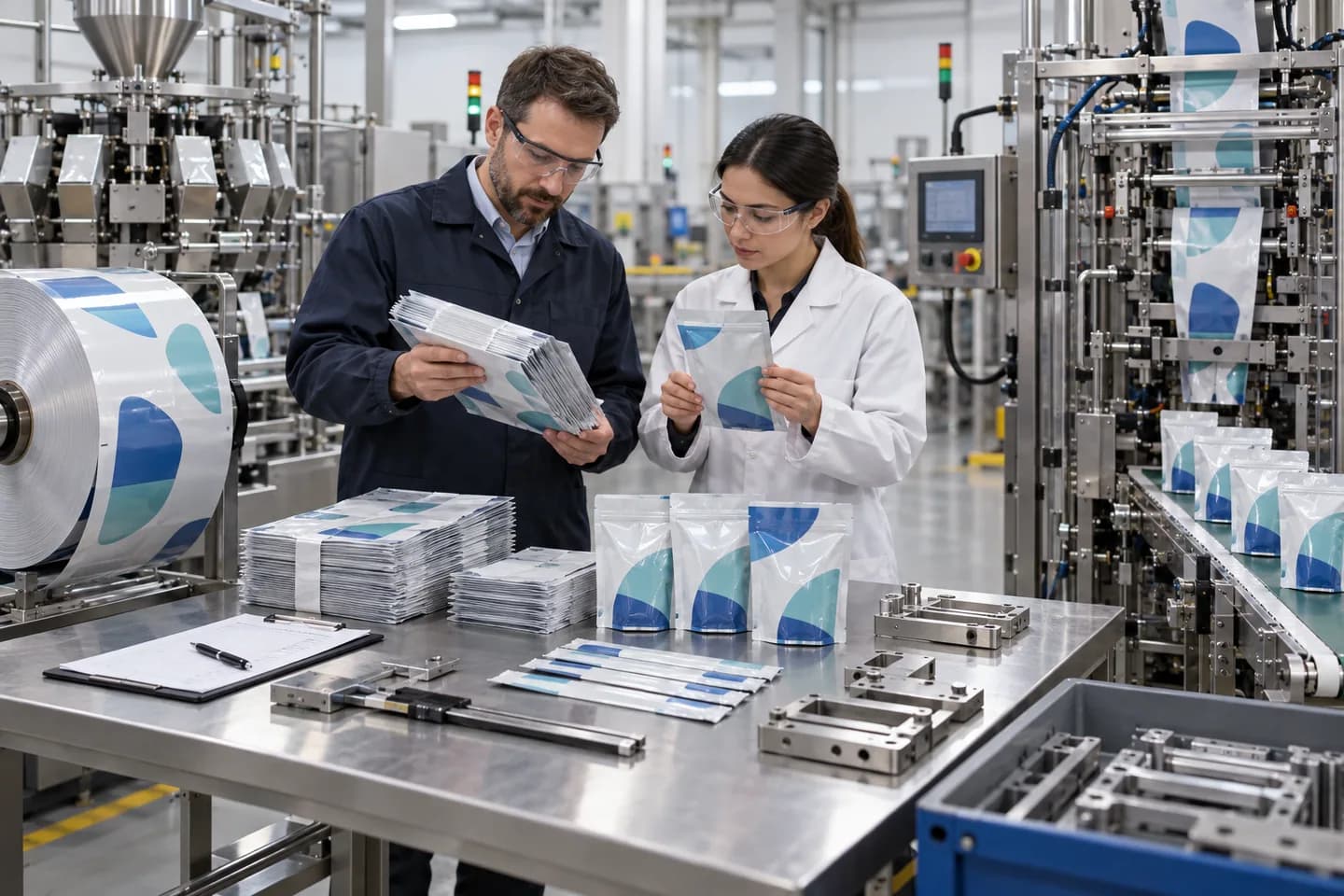
Do not wait for commercial production to discover compatibility. Prepare representative material and product for trials. Agree who supplies trial film or pouches and how many are needed. Confirm utilities, guarding, coding, inspection, reject handling and data collection.
During trials, record speed, stops, failure modes, temperature, pressure, dwell, product giveaway, reject rate and operator observations. Keep samples from stable and unstable periods. The objective is not a short demonstration at maximum speed; it is a repeatable operating window.
Decision Matrix
| Factor | Premade pouches | Rollstock |
|---|---|---|
| Initial equipment route | Manual, semi-auto or premade-pouch filler | Form-fill-seal equipment required |
| Format complexity | Broad specialist formats possible | Limited to machine capability |
| Feature installation | Often completed by converter | Inline capability varies |
| Throughput | Manual to high automation | Often strong for stable high-volume runs |
| Changeover | Pouch and machine recipe/change parts | Roll, threading, registration and tooling |
| Main supply risk | Pouch feeding and finished inventory | Web-machine compatibility and forming control |
| Quality ownership | Converter seals plus packer final seal | More package formation at packer |
Questions for the Equipment Supplier and Converter
- What exact format, size and material range can the line run?
- Which pouch features are compatible?
- What are grip, opening, web tension and seal-area requirements?
- Which trial quantity is needed for acceptance testing?
- What sustained output is expected with our actual product?
- Which change parts are required by size?
- How are dust, crumbs, liquid drips or static controlled?
- Who owns final-seal validation?
- What roll or bundle specifications are critical?
- How will future SKUs and materials be qualified?
What to Include in an RFQ
Send product, fill weight, physical behavior, target package format, dimensions, features, target speed, current or planned equipment, number of SKUs, annual volume, campaign size, artwork, storage and distribution. If equipment is not selected, say so; package and line decisions can then be reviewed together.
Explore all pouch formats, the custom packaging process and contact FULL PACKING with filling-line details.
Working With a Co-Packer
If a third party fills the product, obtain its packaging specification before artwork or pouch dimensions are approved. Ask for acceptable materials, size range, zipper and valve capability, roll direction, maximum roll weight, sealant requirements, code area and trial quantity. Confirm whether it will procure packaging or accept customer-supplied materials.
Clarify ownership of rejects caused by package variation, line setup or product behavior. Agree the evidence needed when troubleshooting and who retains filled and unfilled samples. A co-packer’s prior success with “similar pouches” is useful but does not replace a trial of the proposed structure.
Build a Total-Cost Model
Compare costs per saleable package:
- Packaging material and print setup
- Converting, tooling and change parts
- Filling labor and machine time
- Startup, changeover and cleaning waste
- Product giveaway and rejected product
- Inventory, storage and obsolete artwork
- Quality testing and inspection
- Freight for empty packaging and finished goods
- Maintenance, downtime and spare parts
Use conservative sustained speed rather than brochure speed. Model high- and low-demand scenarios. Premade pouches may have a higher package conversion cost yet lower launch equipment and format risk; rollstock may deliver lower unit economics at stable utilization.
Production Scheduling and Forecasts
Rollstock and premade pouches both benefit from forecasts, but campaign planning differs. A converter may combine printing or material preparation across SKUs while finished pouch conversion remains separate. A filler may sequence allergens, colors or flavors to reduce cleaning.
Share annual demand, order frequency and launch windows while distinguishing forecast from purchase commitment. Define safety stock and reorder points around packaging production plus international freight. Artwork changes should include a run-down plan for obsolete inventory.
Sample and Approval Path
For premade pouches, approve dimensions, opening, features, factory seals and final top seal on the target line. For rollstock, approve web specification, winding, registration, forming, seals and cut-off. A printed mock-up cannot replace machine compatibility.
Use these stages:
- Technical drawing and machine-data review
- Unprinted material or pouch trial
- Artwork and print proof
- Production-representative line trial
- Filled-package inspection and distribution check
- Signed material/package reference and operating settings
- First-commercial-run monitoring
Three Decision Scenarios
Early-stage snack brand
Several flavors, uncertain demand and access to a semi-automatic pouch filler may favor digitally printed premade pouches. The decision should still check zipper feeding, dust in the seal and inventory per flavor.
High-volume single-SKU powder
A stable formulation and dedicated vertical form-fill-seal line may favor rollstock. Web handling, seal contamination, code position and sustained throughput become central.
Premium coffee range
Flat-bottom or side-gusset premade bags with valves may provide format and feature flexibility. A high-volume program could also use rollstock on specialized equipment, but valve application and package formation need integrated validation.
These scenarios illustrate decision logic, not fixed recommendations. The existing plant, co-packer and product determine the answer.
Frequently Asked Questions
Are premade pouches only for small volumes?
No. They can run on automated equipment at commercial scale. Suitability depends on format, line, feed consistency and economics.
Is rollstock always cheaper?
Not always. Compare film, equipment, labor, setup, waste, changeover, inventory and saleable output. Unit material price is only one element.
Can the same machine run every pouch size?
No. Machines have format and dimensional ranges and may require change parts. Confirm the exact proposed pouch or web specification.
Who makes the final seal on a premade pouch?
The filler normally closes the remaining open area after filling. That seal must be validated with the actual pouch, product and equipment.
Should packaging be finalized before buying a filling machine?
Coordinate them. The package affects feeding, forming and sealing; the machine limits size, format and material. Run representative trials before both are locked.
Conclusion
Premade pouches favor format flexibility and can lower the barrier to launch; rollstock can offer efficient integrated formation for compatible stable programs. Decide from the full operating model: product, package, equipment, SKUs, quality ownership, inventory and saleable output.
Send FULL PACKING the product, format, target speed, equipment and volume plan to review packaging inputs for the filling operation.