
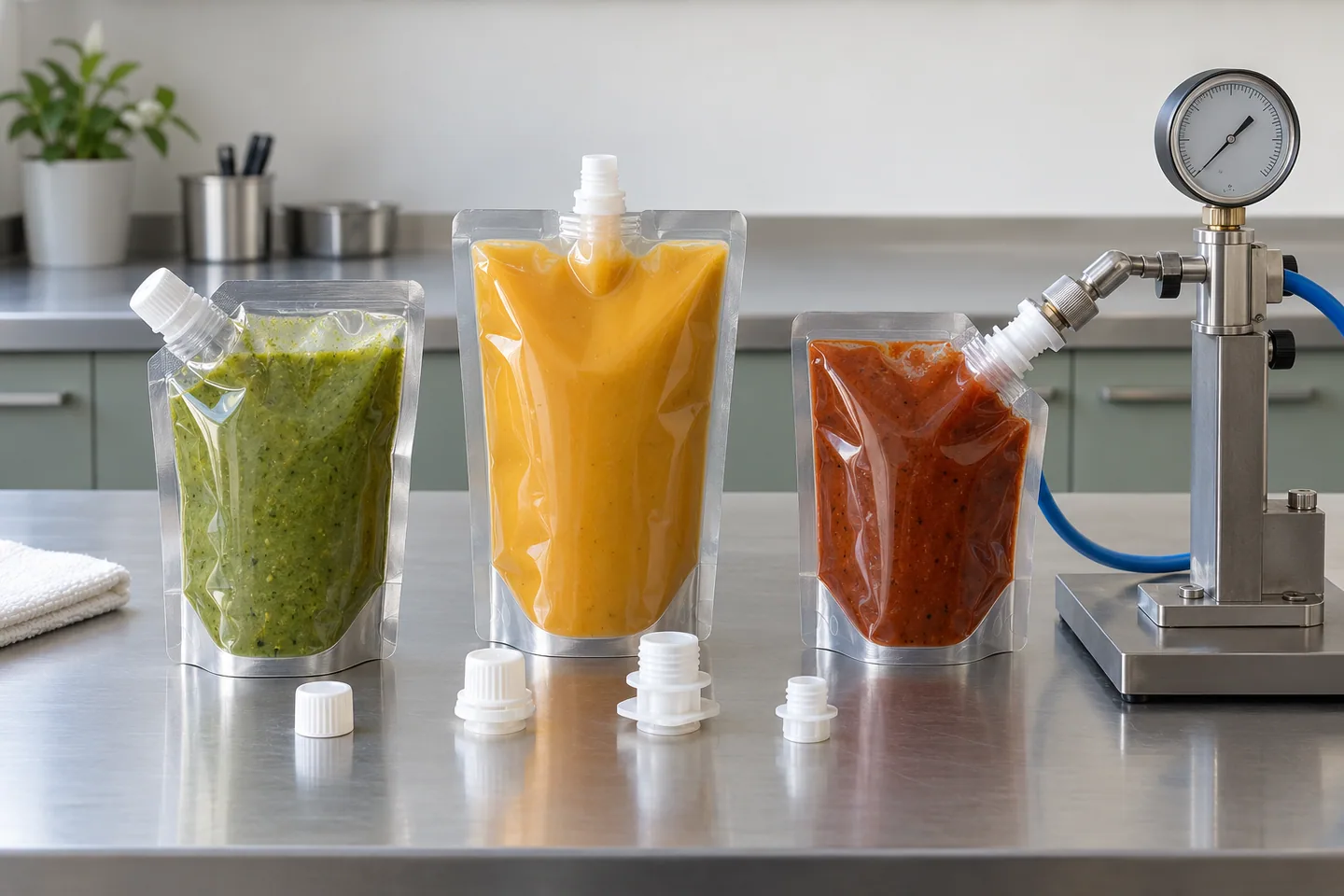
A reliable spout pouch is designed as one system: product, laminate, pouch geometry, fitment, cap, filling process and distribution. The spout diameter must suit viscosity, particles and desired flow; the fitment must weld to a compatible sealant layer; the cap must close consistently; and the finished pack must survive handling without leaking. Selecting a pouch from capacity and appearance alone is not enough.
This guide helps buyers prepare a production-ready brief for sauces, purees, beverages, concentrates and refill products. It does not replace product compatibility, filling-line or regulatory validation.
Begin With the Product
Describe more than “liquid.” Record:
- Viscosity and how it changes with temperature
- Particles, fibers or pulp and their maximum size
- Oil, acid, alcohol or other relevant composition
- Hot-fill, ambient-fill or chilled-fill condition
- Required heating, pasteurization or other process after filling
- Sensitivity to oxygen, moisture and light
- Target shelf life and storage temperature
- Consumer dispensing behavior and serving size
A thin beverage, thick sauce and household refill can require different spouts, films and testing even at the same volume.
Choosing Spout Diameter
Spout bore affects filling speed and consumer flow. A small opening may offer controlled dispensing but restrict viscous or particulate products. A larger opening can fill and pour faster but changes cap size, pouch balance and material use.
Request sample fitments and perform flow trials with the real product at the intended temperature. Observe clogging, stringing, dripping and the force needed to squeeze or pour. If particles are present, confirm that the smallest internal pathway—not only the visible opening—is sufficient.
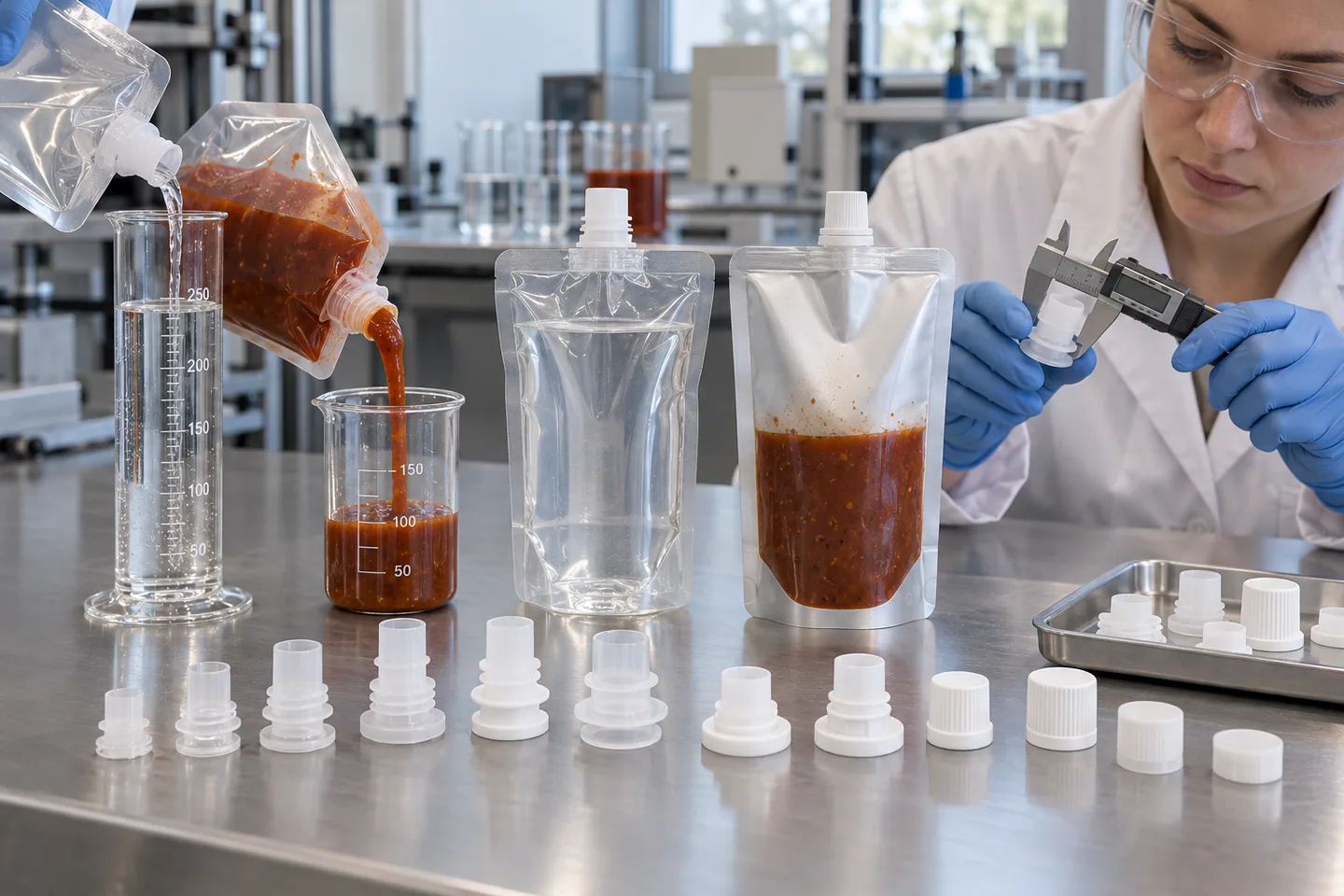
Top-Center vs Corner Spout
A top-center spout can support symmetrical pouring and some filling arrangements. A corner spout can provide a natural pouring angle and leave a different visual balance. The choice affects holding, filling equipment, carton orientation and artwork.
Test filled prototypes with representative users. Check whether the pouch collapses smoothly, whether product remains trapped and whether the cap can be handled without twisting the bag uncomfortably.
Fitment, Cap and Tamper Evidence
The fitment is the molded component welded into the pouch. The cap must match its thread and sealing interface. Available routes can include standard screw caps and project-specific tamper-evident features. Confirm component resin, color, dimensions, torque guidance and destination-market requirements.
Custom colors or components may carry different minimums and lead times from standard parts. Treat fitment and cap specifications as controlled bill-of-material items. A visually similar replacement should not be used without review.
Pouch Film and Fitment-Weld Compatibility
The inner sealant layer must be compatible with the fitment and welding process. Outer layers provide printing, stiffness or barrier; adhesives join layers; the complete laminate must tolerate filling and use.
Hot filling, oily products, acids and cleaning exposure can change requirements. Ask the manufacturer to state assumptions and plan product-contact or migration evidence appropriate to intended use and market. If a mono-material direction is requested, assess the fitment, cap, barrier layers, inks and adhesives as part of the complete recyclability claim.
Pouch Shape, Capacity and Headspace
Nominal volume is not the same as recommended fill volume. Allow headspace for filling accuracy, cap application, expansion and handling. The filled pouch should have a stable base if shelf standing is required and should fit the secondary carton without excessive movement.
Fill prototypes and measure finished width, height and depth. Observe panel stress around the fitment and gusset. If the product is hot-filled, account for cooling, contraction and potential panel deformation.
Artwork Around a Spout
The spout interrupts the pouch outline and may sit near a corner seal. Keep critical text, barcodes and faces away from the fitment-weld zone, folds and trim. Use the approved dieline and review a constructed mock-up.
If the pouch has a transparent window, check product exposure and how the window looks after filling. Metallic or matte effects need physical review because the spout and cap create strong visual focal points.
Filling-Line Requirements
Premade spout pouches may be filled through the spout or through an open pouch before final closure, depending on design and equipment. Confirm:
- Pouch feeding and orientation
- Fitment gripping and indexing
- Fill nozzle diameter and insertion depth
- Product temperature and foaming
- Drip control and fitment cleanliness
- Cap placement and torque control
- Line speed and changeover
- Cleaning method and product-contact controls
Installation preparation should include representative pouches and product. A laboratory hand-fill does not prove automated line performance.
Leak Paths to Evaluate
Body and gusset seals
Inspect for wrinkles, channels, contamination and stress at transitions. Filled weight and drop orientation can load the gusset differently from an empty-pouch test.
Fitment weld
Check the full perimeter where film meets the spout. Geometry creates thick-to-thin transitions that need controlled heat and pressure.
Cap interface
Confirm thread engagement, liner or sealing feature where used, torque and tamper evidence. Over-torque and under-torque can both create problems.
Puncture and flex damage
The cap can contact adjacent pouches in a carton. Use dividers, orientation or protective packing when needed. Test abrasion and impact at likely contact points.

Recommended Validation Sequence
- Component review: fitment, cap and laminate specifications.
- Unprinted prototype: capacity, stance, grip and dispensing.
- Product compatibility: actual formulation under relevant time and temperature.
- Filling trial: feeding, filling, drip control and capping.
- Integrity testing: body seals, fitment weld and cap interface.
- Drop and distribution testing: filled packs in intended cartons.
- Storage or shelf-life study: product quality and package integrity over the target period.
- Production and shipment inspection: dimensions, components, appearance, function, count and packing.
The test method and acceptance criteria should be defined before samples are judged. “No leaks observed” is meaningful only when sample count and conditions are recorded.
Common Spout-Pouch Problems
Slow or inconsistent filling
Review viscosity at fill temperature, nozzle and bore size, air evacuation, foaming and line settings. Do not enlarge the spout without reconsidering cap, pouch geometry and user flow.
Leakage around the fitment
Inspect material compatibility, weld geometry, contamination, temperature, pressure and component variation. Preserve failed and good samples from the same run.
Cap loosens in distribution
Review torque application, thread match, sealing interface, vibration and carton contact. A visible closed cap is not proof of controlled closure.
Pouch tips or deforms
Check fill volume, base geometry, product distribution, material stiffness and cooling. The same dimensions can behave differently with another laminate or formulation.
What to Send for a Spout-Pouch Quote
Provide product description or technical data, viscosity range, particles, fill temperature, fill volume, preferred spout position, cap requirement, filling equipment, target shelf life, pouch dimensions or reference, artwork, quantity per SKU and destination. State whether the project needs stock samples, unprinted prototypes or a production-intent sample.
Review spout pouch options, sauce and liquid applications and zippers, valves and spouts before submitting the brief.
Consumer-Use Testing
Technical integrity is necessary, but a pouch can still frustrate customers. Recruit representative users to open, hold, pour, squeeze, recap and store filled samples. Observe rather than only asking whether they like the pack.
Measure first-open torque where relevant, flow control, dripping, pouch grip, cap retention and product evacuation. Test with wet or oily hands if that reflects use. For children, older adults or food-service staff, handling requirements can differ. Accessibility, tamper evidence and child-resistance are distinct goals and should not be assumed from cap appearance.
Secondary Packaging and Export Delivery
Filled spout pouches can be damaged by cap-to-film contact, carton compression or uncontrolled movement. Develop the carton around the final filled dimensions, not the empty pouch. Consider orientation, dividers, liner bags, stacking, pallet pattern and container environment.
During shipment inspection, verify pouch count, cap application, carton labels and protective arrangement. Use distribution testing that reflects likely drops, vibration and compression. If a pouch passes alone but fails in a densely packed carton, redesign the system rather than only increasing film thickness.
Hygiene and Cleaning Questions for the Filling Operation
Product can remain in the nozzle, fitment neck or cap area. Review cleaning method, changeover, microbial control and drip removal with the filler. The package supplier does not validate the customer’s sanitation process, but fitment geometry and filling route should not make control unnecessarily difficult.
For hot or sensitive products, define maximum time and temperature before filling, closure timing and cooling. Check whether condensation or product residue affects cap sealing, labels or cartons.
Commercial Planning for Spouts and Caps
Components can have separate minimum purchase quantities, color batches and lead times. Ask whether standard fitment colors or diameters are stocked and how a custom component changes the project. Maintain approved physical samples and component codes to avoid a visually similar but functionally different substitution.
For multi-SKU programs, determine whether different flavors can share the same pouch body, spout and cap. Standardizing components can reduce complexity, but only if product compatibility, color coding and line cleaning remain acceptable.
Spout-Pouch Approval Checklist
- Product data and intended-use conditions recorded
- Fitment bore, position, resin and supplier confirmed
- Cap and tamper-evident route approved
- Laminate and fitment-weld compatibility reviewed
- Filled capacity, headspace and stance accepted
- Artwork clearances checked on a constructed sample
- Filling and capping trial completed
- Body, fitment and cap leak paths tested
- User dispensing and reclosure assessed
- Carton, distribution and shipment inspection defined
Frequently Asked Questions
Which spout diameter is best for sauce?
It depends on viscosity, particles, temperature, filling nozzle and desired pour rate. Test sample fitments with the actual sauce.
Can a spout pouch be hot filled?
Only when the complete laminate, fitment, weld, cap and process are designed and validated for the intended temperature and product.
How do you test a spout pouch for leaks?
Use methods that address body seals, fitment weld and cap interface, then test filled packages through expected handling and distribution. Record conditions and sample size.
Is a spout pouch recyclable?
The answer depends on the complete material and component construction plus local collection, sorting and recycling rules. Do not infer recyclability from the pouch body alone.
Should I choose a corner or center spout?
Compare filling equipment, pouring motion, pack balance, shelf appearance and carton orientation using filled prototypes.
Conclusion
Spout-pouch performance comes from coordinated decisions. Start with product rheology and filling, then select fitment, cap, laminate and geometry; validate every leak path with filled samples and representative distribution.
Send FULL PACKING your product, fill volume, viscosity, filling temperature, spout preference and target quantity to plan the next sample step.